

After The Siege
Dollar Dominance in the Age of War, Oil & BRICS

The transition we warned about has arrived faster than anyone predicted. A war in the Middle East, a fractured petrodollar, and a BRICS settlement system that now clears $6 trillion annually — the financial architecture of the 20th century is dissolving in real time.
PUBLISHED March 25, 2026 SERIES - Dollar Dominance Under Siege
SOURCES: IMF · LSEG · S&P Global · BIS · Caribbean Development Bank
One year ago, we published Dollar Dominance Under Siege — a warning that China’s digital yuan, India’s strategic pragmatism, and the expanding BRICS bloc were combining to erode the dollar’s unipolar grip on global finance. We identified five pathways Caribbean nations should take to survive the transition. Fourteen months later, the siege has moved from the perimeter to the gates.
The catalyst no one had fully priced in was the February 28, 2026 outbreak of direct US-Israel military strikes on Iran. Far from stabilizing the region, this event detonated a petrodollar landmine that had been quietly accumulating pressure for years. Within six days of the first strikes, crude oil broke above $130/barrel. Within three weeks, four Gulf states had announced emergency consultations with China’s CIPS settlement system. Within six weeks — where we stand today — the global currency map looks measurably different from the one we described in March, 2025.
This follow-up interrogates what has changed, what has accelerated, what failed to materialize — and, critically, where the Caribbean stands as the tectonic plates of global finance shift beneath its feet.
KEY INDICATORS · Q1 2026

The Petrodollar Fracture
The Shot Heard in Tehran — And Felt in Every Central Bank
The petrodollar system — the arrangement by which oil is priced and settled in US dollars, recycling Gulf surpluses back through US Treasury markets — has been under structural stress since at least 2014. What the Iran conflict did was accelerate that stress into a fracture event.
Within the first three weeks of sustained strikes, Saudi Arabia moved to settle a tranche of Chinese oil contracts in yuan through CIPS rather than SWIFT. This was not a rhetorical gesture or a sanctions workaround — it was an operational pivot by the world’s largest crude exporter. The UAE followed within days, activating a bilateral yuan settlement track that had been quietly operational since 2023 but rarely used.
“When the world’s largest oil exporter invoices its largest customer in a non-dollar currency during an active military conflict, the petrodollar is no longer a system — it is a historical artifact.”
— BIS Quarterly Review Analyst Dispatch, March 2026
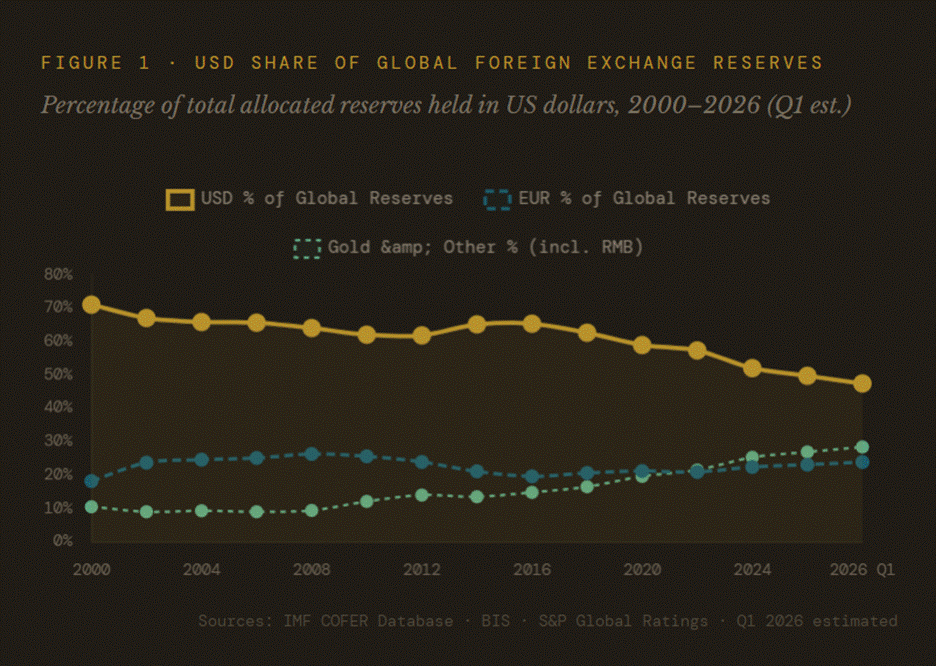
The mechanics matter here. Under the classic petrodollar loop: oil exporters earn dollars → park them in US Treasuries → finance American deficits → maintain dollar demand. When oil trade denominated in yuan rises, that loop weakens structurally. Treasury demand softens. Dollar supply globally expands relative to demand. The currency faces downward pressure at precisely the moment the US is running its largest peacetime deficit-to-GDP ratio since 2020.
What distinguishes the 2026 moment from earlier de-dollarization scares — such as the 2022 post-Ukraine period — is that three conditions are simultaneously present: a functioning alternative settlement infrastructure (CIPS/digital yuan), a geopolitical trigger that creates urgency to use it, and a US administration with reduced diplomatic capital to punish defectors.
China & BRICS
The Digital Yuan at Scale — and the Settlement System Beneath It
Our 2025 analysis noted the digital yuan had reached 7 trillion RMB (~$987B) in cumulative transactions in 2024. By Q1 2026, that figure has nearly doubled to an estimated 12.7 trillion RMB, according to S&P Global’s February 2026 CBDC tracking report. More significant than the volume is the geography of its expansion.
The 16-country cross-border settlement network we cited in 2025 has grown to 23 participating nations, now including Indonesia, Kazakhstan, and — in a development that would have been unthinkable in 2022 — three Eastern European nations that joined to hedge against US sanctions risk following secondary tariff threats. Saudi Arabia and the UAE are running parallel yuan and dollar settlement tracks for oil exports, effectively operating a two-lane highway where the yuan lane is widening.
BRICS Clear and the $6 Trillion Threshold
BRICS Clear — the SWIFT alternative we described as nascent in 2025 — has crossed what analysts consider the threshold of systemic significance: $6.1 trillion in annual settlement volume. For context, SWIFT processes approximately $150 trillion annually, so BRICS Clear remains a fraction. But its growth trajectory is exponential rather than linear, and its recent integration with Russia’s SPFS and China’s CIPS into a unified messaging layer means it now represents a fully functional alternative architecture, not merely a pilot program.
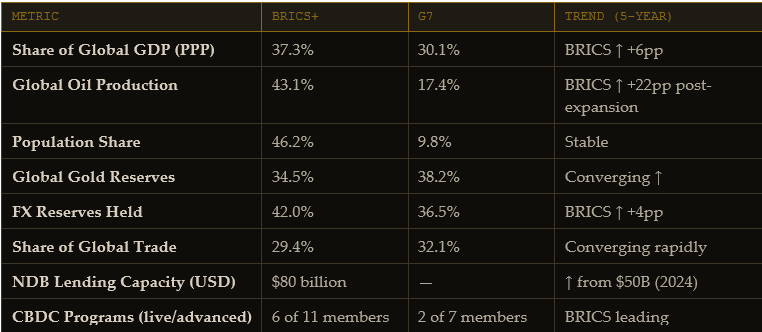
Table 1 · BRICS+ vs G7 — Key Economic Metrics 2026
Comparative economic weight across six dimensions; % of global total
Sources: IMF World Economic Outlook April 2026 · World Bank · IEA · WGC
Context: BRICS Currency Proposal Status
The shared BRICS currency proposal — floated aggressively at the 2023 Johannesburg Summit — has been formally shelved as a near-term project after resistance from India and Brazil. What has progressed in its place is a multilateral local-currency settlement framework: bilateral currency swap lines between BRICS members that allow trade to be invoiced and settled in either party’s domestic currency without conversion through dollars. As of March 2026, 14 active bilateral swap lines exist within the bloc, up from 7 in 2023.
