

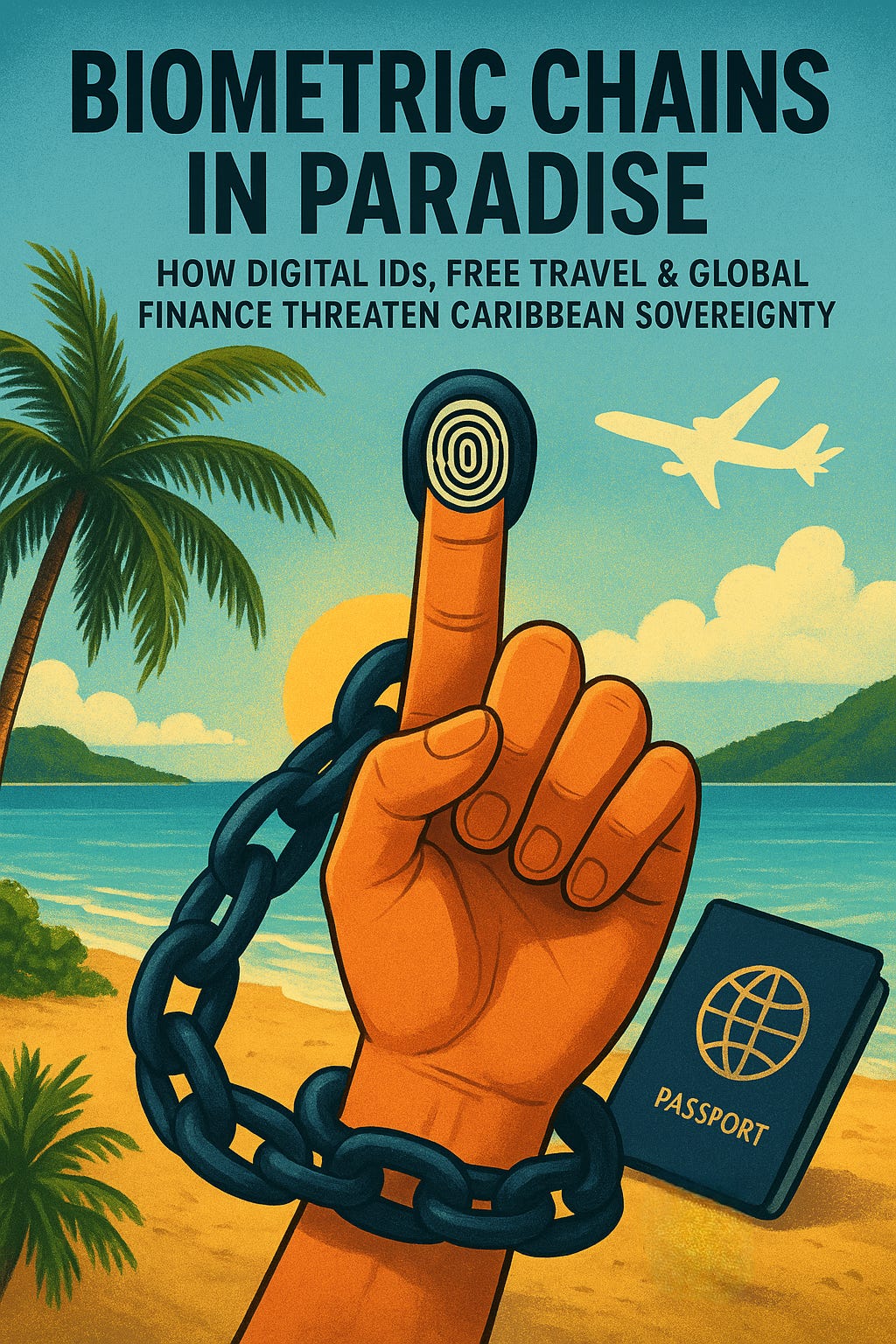
Biometric Chains in Paradise
How Digital IDs, Free Travel & Global Finance Threaten Caribbean Sovereignty

Introduction
Imagine a Caribbean where a handshake with your bank, your birth certificate, or even your vote depends not on your nationality, but on having your face, iris, fingerprints—every biometric marker—logged, stored, and tethered to a digital profile. Where moving between Barbados, Dominica, or St. Vincent isn’t just a matter of passport-free borders, but of submitting to invisible systems of control.
It sounds like dystopian fiction—but it’s rapidly becoming policy reality in the Caribbean. Across the parish borders and over the blue seas, an interconnected web of digital ID mandates, Central Bank Digital Currencies (CBDCs), biometric data collection, and global financial rulebooks is being woven. What is sold as progress, inclusion, and efficiency is increasingly looking like surveillance, loss of agency, and erosion of sovereignty.
Here we combine the voices of experts warning of this shift with global case studies and local policy trends to map out the abuses, contradictions, and geopolitical motives underpinning the rapid rollout of digital IDs and free movement agreements. By the end, it should be clear: the stakes for ordinary Caribbean men, women, and children are far higher than many realize.
Paid subscribers recieve additional benefits like discounts at our online shop, access to additional content, etc.
The Tech Is the Tentacle – Digital IDs, CBDCs & Global Policy Machinery
The sweeping global design described is as follows:
Governments, banks, and international institutions are pushing digital IDs that are intricately tied to your physical identity—face, iris, fingerprints. These IDs are mapped to your physical documents and biometric markers.
CBDCs (Central Bank Digital Currencies) and digital financial systems are laid out as inseparable from digital IDs. Without a digital identity, the argument goes, one cannot operate in the new financial ecosystem.
Key policies and global institutional actors (United Nations, Bank for International Settlements, ID2020, Digital Impact Alliance, etc.) are explicitly framing digital ID + digital currency as essential to fulfilling Sustainable Development Goals (especially SDG 16.9: legal identity for all from birth).
The use of biometrics in food assistance, refugee registration (e.g. UN’s “Building Blocks”), or in checking out rations with an iris scan are no longer theoretical. They are already in use.
The tech architecture isn’t vague. It is meant to collect, standardize, aggregate, and make interoperable massive personal data sets. Even the rhetoric of decentralization, vendor‐agnostic models, or “trusted third parties” is undercut by the fact that many of the same actors—big banks, governments, global organizations—are deeply involved in every stage.
But this global architecture is not benign. As many have noted:
Exclusion & Identity Gaps: For people who lack ID (especially poor, rural populations, refugees), digital IDs are being presented as the solution. But implementation often fails those most vulnerable. Requirements (proof of birth, documents, biometrics) and digital divides (no internet, no tech, illiteracy) put many outside the system. When digital ID becomes mandatory for healthcare, banking, travel, social benefits or moving freely, lacking one can become a sentence to non-citizenship or worse. Salzburg Global+2Unwanted Witness+2
Mass Surveillance, Data Control, Weaponization: With enough data, everything—from where you travel to how you vote to what you buy—becomes traceable. This makes dissent, resistance, or privacy ever more difficult. Policy documents explicitly tie digital IDs, digital financial systems, and programs like vaccine passports, stablecoins, etc., to mechanisms of control.
Centralized, Not Decentralized: Although rhetoric often promises decentralized or user-controlled ID (blockchain-based, vendor agnostic), the actual administration is often tightly controlled by central authorities, financial institutions, or global banks. The “trusted third parties” still tend to be powerful entities.
Debt, Financial Leverage, & Geopolitical Drivers: Countries are being influenced, compelled, or incentivized—often via debt, loans, or conditional funding—to adopt these systems. The sustainable development agenda is used as a policy lever. Promoters claim digital ID + CBDCs are necessary for financial inclusion and modernizing states—but also to ensure control, compliance, and integration into global financial architecture where data flows to powerful nodes.
These form the backdrop against which Caribbean nations are now making rapid moves toward free movement, deep integration, and digital identification regimes.
Caribbean Free Movement & Digital ID – A Dangerous Marriage
While on the surface the Caribbean free movement initiative (among Barbados, Dominica, Belize, and St. Vincent & the Grenadines) appears to be a long-desired integration, there are deep undercurrents.
Promises
Full free movement as of October 1, 2025: citizens of these countries now have the right to enter, live, work, and remain indefinitely without visa or residency permit. They also have access to primary and secondary education and emergency and primary health care in other member states. CARICOM+2ABC News+2
The idea of economic integration, lowering cost of cross-border business, facilitating labor movement, unity, creating a larger “market” so that the small states collectively are less vulnerable, and can pull more weight in the global system.
But wider research confirms, that along with these promised benefits come serious risks.
Abuses, Contradictions & Hidden Motives
Digital ID as Control Mechanism
To move freely, a digital identity is required. Free movement is framed as an experiment in control: if you wish to cross from Dominica to Barbados, you must have the “digital ID,” tethered to your bank, your biometric data, your digital wallet. There’s no neutrality in these systems—they are political, electoral, technological tools.
In Barbados, the Trident Digital ID is reportedly an implementation run through the Electoral and Boundaries Commission. Once citizens sign up, their “card” is seen by critics as not just identification but a way to influence or lock votes, manipulate electoral outcomes, or enforce belonging to certain political entities.
Lack of Democratic Oversight / Public Consent
Many programs are rolled out without referendums, public debate, or even input from citizens. Free movement & digital ID pilots have been introduced “behind the scenes,” without stakeholder consultation.
Policy architecture is set by external entities—UN, global financial institutions, private tech firms—rather than grassroots democratic institutions. These systems tend to be “top-down.”
Economic Imbalances & Social Discord
Free movement without a single value currency or income equalization leads inevitably to migration from lower-wage to higher-wage countries, straining the social and infrastructural capacities of host countries. But also, people who move might find that higher nominal wages are eaten by much higher cost of living, rent, utilities, etc. In Barbados, utilities alone are said to cost over USD 300 per month for a family of four—among the highest in the region.
Disparities in wage, cost of living, infrastructure, educational and health resources will create tension. Not everyone can move easily; many will be “left behind.”
Surveillance, Loss of Privacy, Possible Voting & Political Manipulation
Once travel, banking, health, social services are tied to a single digital identity, you create a universal “control lever.” Noncompliance (refusing to share your biometrics, refusing a digital ID) could become exclusion.
Migrant or “new citizen” voters with digital IDs could be encouraged or pressured (implicitly or explicitly) to vote in certain ways, strengthening incumbent power.
The threat of external entities influencing policy via control over digital ID systems is raised. Who owns the databases? Who can access them? Which laws govern cross-border data flow?
Sovereignty at Risk
Nations are giving up bits of legal/policy control when they subscribe to international treaties or frameworks that bind them to certain standards, technology vendors, or systems.
The push for digital ID and CBDC is global. The same models are advocated by the BIS, the UN, major foundations. Caribbean nations are essentially entering into arrangements that embed them into global governance regimes and financial systems, with attendant rules, surveillance, and conditionality.
Global Case Studies That Mirror Caribbean Warning Signs
To understand where this path could lead, we examine global examples.
Uganda – Exclusion and State Surveillance
The Ndaga Muntu digital ID program in Uganda: mandatory, biometic, required for basic rights—access to healthcare, social benefits, travel, mobile phones. Yet, one third of the adult population reportedly has not obtained the ID, with many experiencing errors or loss. Without the ID, people cannot access lifesaving rights. Unwanted Witness
This shows how digital ID can become gatekeeper—and if implemented poorly, many are shut out.
Kenya – Data Risks and Exclusion
In Kenya, the National Integrated Identity Management System (NIIMS) faced criticism for lack of transparency, for structural risks to privacy, for risk of data misuse, and for excluding populations historically marginalized. NGOs raised legal cases over the human rights risks posed by its implementation. Business & Human Rights Resource Centre
Jamaica – Legal Pushback
Jamaica’s National Identification and Registration Act (NIRA) was ruled unconstitutional due to mandatory enrollment and lack of safeguards. People feared being forced into identity systems without clear oversight. Biometric Update
These cases warn the Caribbean: rushed policy, lack of oversight, mandatory biometric data, and hiding of “opt-out” mechanisms tend to produce abuses rather than justice.
Geopolitical Motives & Who Stands to Gain
To explain why Caribbean governments, NGOs, and international institutions are rushing into these systems, we must look beyond technical efficiency and humanitarian rhetoric.
1. Global Finance & Sustainable Development Frameworks
The UN’s Sustainable Development Goals (SDGs), especially SDG 16.9 (“legal identity for all from birth”), are a policy lever. They are backed by reports, funding, treaties, and institutional expectations. States sign on. Funding comes with strings.
The multilateral development banks, IMF, World Bank are pushing debt-financed programs tied to identity, inclusion in financial systems, digital financial inclusion. The rhetoric is that digital IDs and CBDCs are essential for modernizing economies, fighting corruption, ensuring access to services—but also for tracing and controlling financial flows globally.
2. Tech Corporations, Foundations & Private Interests
Entities like ID2020, technology firms (including those specializing in biometric hardware / software, blockchain, digital wallets), philanthropic foundations (e.g. Gates, etc.) are deeply involved in defining technical standards, funding pilots, creating models.
The push for “vendor agnostic,” “decentralized,” “blockchain-based” IDs often hides the reality that many vendors are deeply connected—and that once infrastructure is in place, switching costs, vendor lock-in, data path dependencies give outsized power to tech companies and financiers.
3. Political Control & Electoral Leverage
Digital ID + access to essential services = leverage. Whoever controls the gatekeepers controls access to education, health, banking, employment.
This gives incumbents tools to influence votes, exclude dissent, marginalize those without required IDs, influence migration patterns.
4. External Influence & Neocolonialism
The “global rules-based order,” the rising influence of institutions like BIS, UN policy frameworks, external lenders, foreign foundations, all embed power in global nodes rather than in local decision-making.
Caribbean nations are not immune: agreements with UN, EU declarations, foreign philanthropic foundations bring norms, standards, and sometimes technology that is developed elsewhere—and which may not have local oversight, local cultural fit, or sensitivity to local constitutional rights.

How Things Could Unfold – Scenarios for the Caribbean
Putting together what is being built, here are some plausible scenarios—some warning, some hopeful—depending on how decisions are made in the next few years.
Scenario A: The High Control Regime
All citizens are required to apply for digital IDs tied to their biometrics. Without them, movement, banking, voting, employment, education are severely restricted. A two-tiered system emerges: those compliant with digital systems live “within the rules,” others are marginalized.
Digital financial transactions get logged; CBDCs become programmable: “smart money” that can be blocked or controlled for political or economic reasons—e.g., restricting expenditures, minimum balances, or access.
External entities (global banks, tech firms) maintain control over infrastructure, data flows. Sovereignty becomes nominal: governments are managing branches of a global digital governance system rather than independent nations.
Scenario B: Unequal Integration & Internal Friction
Free movement is realized, but economic and wage differentials lead to mass migration from smaller or poorer states to richer ones (e.g. Barbados). This strains infrastructure, raises xenophobia, heightens rent/property inflation in host states, dampens wages in some sectors due to labor competition.
Smaller states lose workforce, brain drain intensifies. Regions of cultural, religious, economic difference feel squeezed or marginalized.
Citizen frustration mounts; informal economies persist outside digital systems (unbanked, undocumented/unenrolled). Tensions over who counts as “citizen,” who gets digital ID, who doesn’t.
Scenario C: Pushback & Reform
Citizens raise strong objections—through courts, referenda, public campaigns—against mandatory digital IDs, data privacy abuses, electoral manipulation. Legal challenges overturn parts of legislation.
Caribbean nations negotiate stronger safeguards: constitutional protections for privacy, data ownership, opt-outs, independent oversight, strict limits on data sharing.
A regional agreement may emerge: Caribbean model of digital identity built on local values, sovereignty, transparency, with user control and minimal surveillance.
Contradictions That Cannot Be Overlooked
While the narrative often is “digital ID + free movement = inclusion and modernization,” research expose these contradictions:
Inclusion vs Exclusion: The rhetoric is “leaving no one behind.” But those without birth certificates, with disabilities, living in remote areas, or lacking digital literacy are marginalized. Ironically, the poorest are often the first to be excluded.
Decentralization vs Centralization: Promises of blockchain, vendor-agnostic systems, decentralized IDs are appealing. But in practice, central banks, governmental authorities, global institutions are building heavy centralized control points where everything must be interoperable—and hence, monitors can gain access.
Freedom of Movement vs Control of Movement: Free movement sounds liberating. But with mandatory digital IDs, tracking/tracing, biometric verification, “trusted third parties” and surveillance, movement becomes conditional and controlled.
Sovereignty vs Dependency: Governments are surrendering aspects of administrative control: how ID systems are built, who controls the data, what legal norms apply, who audits, who profits. In return, they receive loans, funding, access to global supply chains—but at cost of autonomy.
Equality vs Hierarchy: Though many documents talk about equality, the reality is often unequal. Some states are more advanced, wealthier; some citizens benefit enormously; others become data shadows, disenfranchised. The few get the perks; the many get mandated compliance.

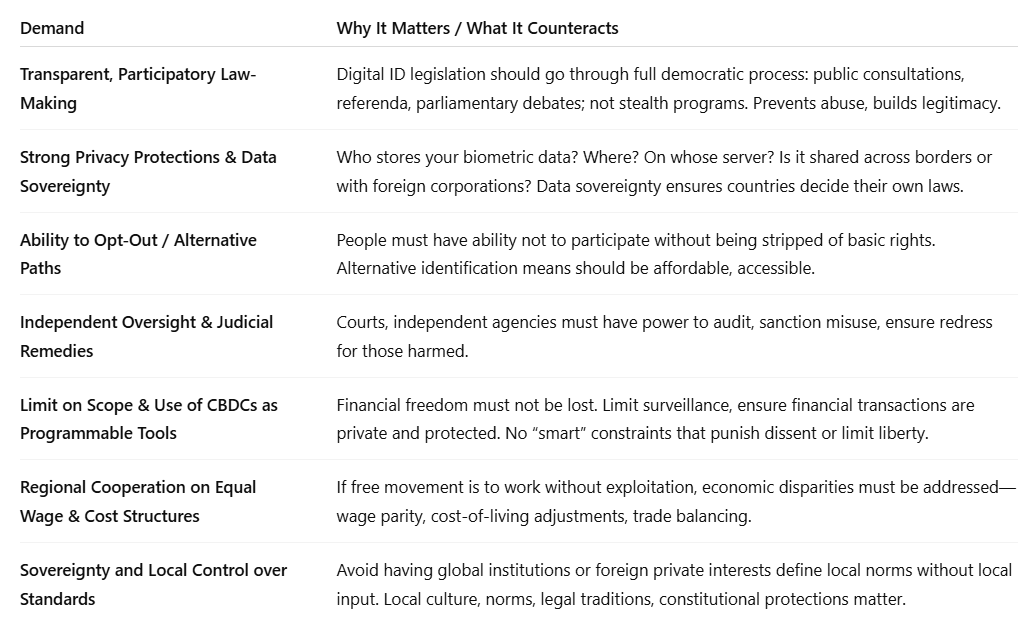
What Must Be Demanded – A Roadmap for Resistance & Responsible Use
Given what’s at stake, Caribbean citizens, civil society, scholars, and governments must act. These aren’t just policy recommendations—they’re urgent demands if freedom, democracy, dignity are to survive in the digital age.
Choice in the Crossroads
The Caribbean today stands at a crossroads. The paths diverge: one leads to inclusion, sovereignty, dignity. The other—and it is increasingly being built brick by brick—leads toward control, dependency, loss of autonomy.
The forces pushing forward are enormous: financial capitals, international institutions, technology firms, global policy agendas. Their rhetoric is powerful—“inclusion,” “modernization,” “rights,” “equality.” But the devil is in the design.
If digital IDs become gateways to all rights and services, then they are also gates to exclusion. If free movement requires digital profiles, then without them, you are left behind. If sovereignty is ceded in data policy, if citizens are silent while their rights are made conditional on invisible architectures—then we may wake up one day to find that the paradise we call home has been quietly mapped, measured, and managed.
This is not inevitable. It is a choice. The Caribbean must insist on transparency. On constitutional guardrails. On people before platforms. Because digital futures that ignore democracy, justice, and rights are neither modern—they are chains in silicon.