

BlackRock's Global Empire
The Invisible Hand Reshaping Finance, Energy, and Sovereignty

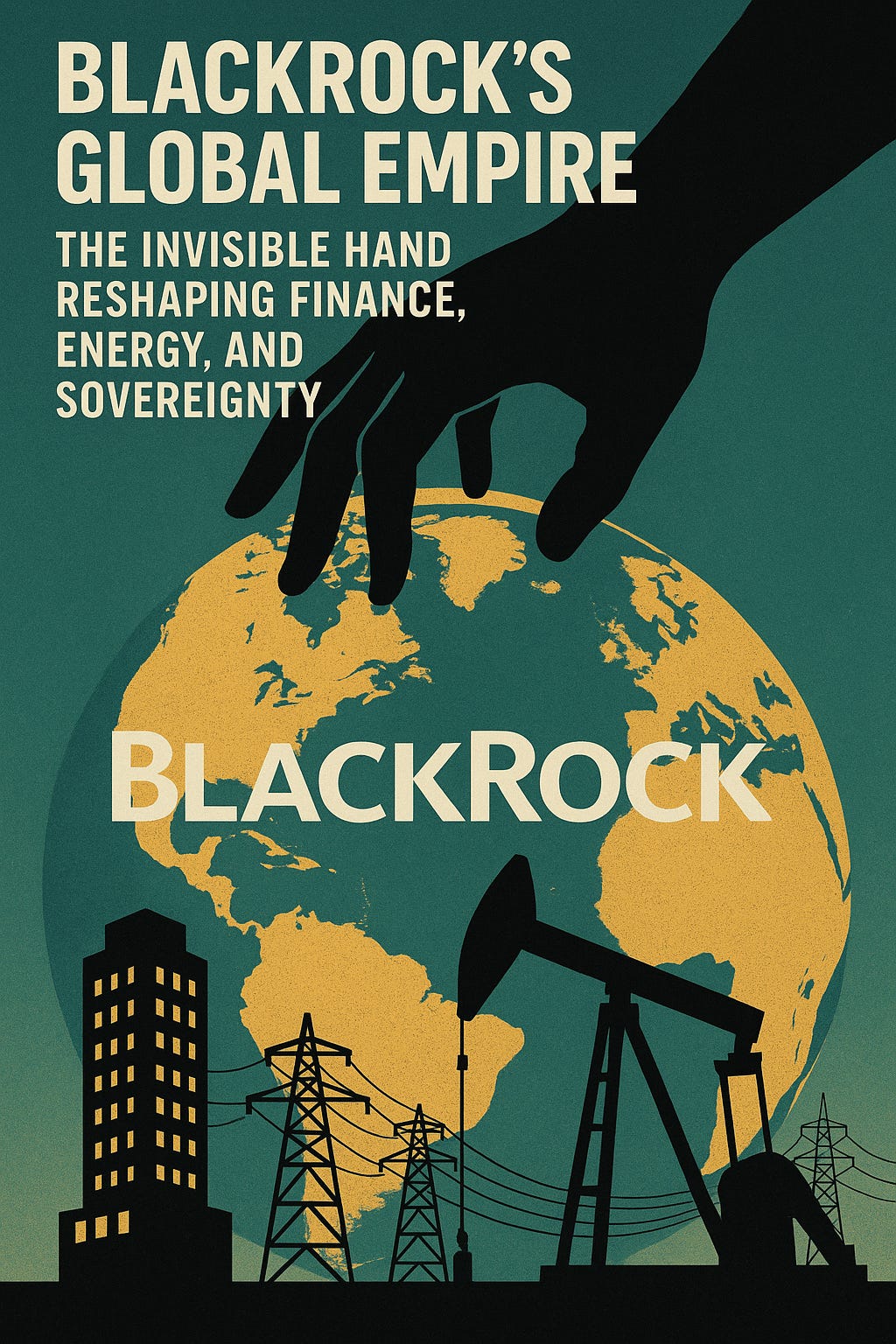
In a world increasingly defined by competing power centers and economic uncertainty, one entity stands above nations, silently accumulating unprecedented control over global assets, infrastructure, and policy. This isn't just another multinational corporation—it's BlackRock, the world's largest asset manager with over $10 trillion under management, wielding influence that extends far beyond Wall Street into the very fabric of international governance and sovereignty.
The truth is stark: while citizens focus on elected officials and traditional power structures, BlackRock has methodically constructed a parallel empire that transcends borders and traditional concepts of nation-state sovereignty. From housing markets to energy infrastructure, from disaster capitalism to cryptocurrency, BlackRock's tentacles reach into every aspect of modern life.
Help support our efforts by becoming a Member, making purchases from our Shop or by donating to our Goal. Click on Member, Shop or Goal now!
The Corporate Colonization of Global Finance
BlackRock's rise isn't merely about wealth accumulation—it represents a fundamental shift in how power operates in the 21st century.
The Asset Management Revolution: BlackRock's Breathtaking Portfolio in the US
BlackRock's investment strategy involves owning significant stakes in competing companies across virtually every major industry:
Technology Giants: Major investments in Apple, Microsoft, Amazon, Alphabet, Meta, and Tesla, giving BlackRock influence across the entire tech landscape
Banking Sector: Substantial holdings in JPMorgan Chase, Bank of America, Citigroup, and Wells Fargo
Pharmaceutical Industry: Controlling interests in Pfizer, Johnson & Johnson, Moderna, and Merck
Energy Sector: Significant positions in both traditional energy (ExxonMobil, Chevron) and renewables (NextEra Energy, First Solar)
Defense Contractors: Stakes in Lockheed Martin, Raytheon, Boeing, and General Dynamics
Media Conglomerates: Investments across Disney, Comcast, News Corp, and Paramount
Retail Giants: Major holdings in Walmart, Target, Costco, and Amazon
Food and Agriculture: Positions in companies like Monsanto/Bayer, Archer-Daniels-Midland, and major food producers
Through its Aladdin risk-management system, BlackRock effectively controls investment decisions for assets worth over $21 trillion—more than the GDP of the United States. This platform isn't just a tool—it's a financial central nervous system directing global capital flows.
The Housing Crisis Architect
BlackRock has emerged as one of the largest single-family home purchasers in America, fundamentally altering housing markets:
Following the 2008 financial crisis, BlackRock and other institutional investors purchased foreclosed homes at bargain prices, converting them to rentals
In 2021 alone, institutional investors bought nearly 1 in 7 homes in major metropolitan areas
Their strategy typically involves paying 20-50% above market value, deliberately inflating housing costs
In markets like Atlanta, Phoenix, and Charlotte, BlackRock subsidiaries own tens of thousands of single-family homes
These practices have contributed significantly to housing unaffordability, effectively locking millions of Americans out of homeownership
What appears as a housing affordability crisis is, in reality, a coordinated transfer of property from individual ownership to corporate landlords, creating a permanent renter class dependent on financial giants for basic shelter.
Infrastructure: The New Colonial Frontier
Beyond housing, BlackRock has aggressively targeted essential infrastructure:
Water Systems: Investments in private water utilities across North America, Europe, and developing nations
Energy Grids: Controlling interests in electrical utilities and transmission systems globally
Transportation Networks: Stakes in toll roads, airports, seaports, and rail systems
Digital Infrastructure: Heavy investments in data centers, cell towers, and fiber optic networks
Healthcare Facilities: Ownership of hospital systems, clinics, and medical office buildings
These aren't just financial investments—they represent control over the vital systems that nations depend on for survival and sovereignty. When a foreign power owns your ports, water systems, and energy grid, traditional concepts of national independence become meaningless.
Help support our efforts by becoming a Member, making purchases from our Shop or by donating to our Goal.
The Government-BlackRock Revolving Door
BlackRock's influence isn't just economic—it's deeply political, with personnel connections that blur the line between public and private power:
Personnel is Policy
Notable revolving door examples include:
Brian Deese: BlackRock's Global Head of Sustainable Investing became Director of the National Economic Council
Thomas Donilon: BlackRock's Chairman of Investment Institute previously served as National Security Advisor
Wally Adeyemo: Former Chief of Staff to BlackRock CEO became Deputy Secretary of the Treasury
Michael Pyle: BlackRock's Global Chief Investment Strategist became Senior Economic Advisor to the Vice President
Adewale Adeyemo: Served as senior advisor at BlackRock before becoming Deputy Secretary of the Treasury
Numerous European Officials: Including former finance ministers and central bankers now employed by BlackRock
This revolving door ensures BlackRock's interests are represented at the highest levels of government policy-making around the world.
Policy Influence Mechanisms
Beyond direct personnel connections, BlackRock shapes policy through:
Authoring white papers that become blueprints for central bank policies
Providing "technical assistance" to governments making critical economic decisions
Funding academic research that supports their preferred policy frameworks
Extensive lobbying operations across multiple countries
