

PAVED OVER
How Grenada's Design-Build-Finance-Maintain model sidelined local contractors — and handed the nation's roads to three foreign firms with troubled track records.


THE HANDOVER
A St Lucian company is now doing something no Caribbean flag company had done in Grenada before: mining, mixing, and pouring its own concrete and asphalt, on its own terms, for government roads across the island. Rayneau Construction Group first entered Grenada years ago to fix a landslip-damaged stretch of the western main road at Molinere, a project the government originally targeted for completion by December 2023. It still is not finished. As late as March 2025, the Prime Minister told Parliament that a bridge forming part of that same repair still lacked a proper asphalt surface; more than a year later, the Grenadian firm subcontracted to pave it, CCCCI, publicly confirmed the surface remained below design standard, and pointed at both a payment dispute and Rayneau’s own site preparation as the cause. In the meantime, Rayneau has built a concrete batching plant in Woodford and a hot-mix asphalt plant in Beausejour, expansions residents say happened without proper consultation and that are now the subject of a formal legal challenge. A few miles away, a Trinidadian company called Namalco is already paving one of two major roads it was hired to design, build, and finance, at a price the government has never disclosed — the same Namalco a Trinidad and Tobago court has found conspired with a state agency’s own chief executive to inflate infrastructure invoices by hundreds of millions of dollars. And currently, Grenada is doing business with Kallco, a Trinidadian road contractor that Guyana’s government stripped off a billion-dollar highway project in 2024 and effectively declared unfit to work again.
None of this happened in the shadows. It happened in press briefings, in parliamentary budget debates, and in a policy the Prime Minister has described, without much elaboration, as the government’s new way of getting roads built: Design, Build, Finance, and Maintain, with the contractor paid back by the state over time once the work is done. What has not happened, at least not publicly, is a full accounting of who these companies are, what they have left behind on other islands, and why Grenadian contractors are largely watching from outside the fence.
The Mechanism: How ‘Finance’ Became the Workaround
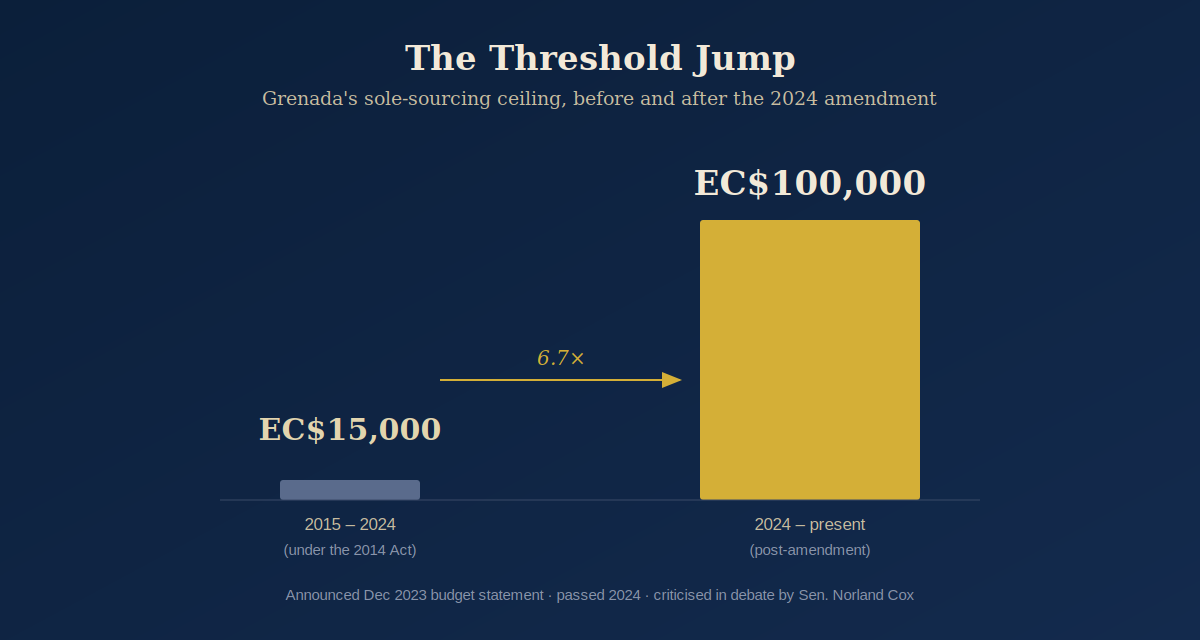
Grenada’s public procurement is governed by the Public Procurement and Disposal of Public Property Act of 2014 and its 2015 regulations, a framework built, in the law’s own words, around accountability, transparency, integrity, and value for money. It sets a sole-sourcing threshold — currently EC$100,000 — above which competitive tendering is meant to be the default, not the exception.
That threshold has itself moved, and moved recently. For nearly a decade after the Act took effect in 2015, the sole-sourcing ceiling stood at EC$15,000 — above that figure, government was required to seek competing bids rather than hand work to a single supplier. In its December 2023 budget statement, the Mitchell administration announced it would raise that ceiling more than sixfold, to EC$100,000, with Finance Minister Dennis Cornwall telling Parliament the procurement law had become too cumbersome and was slowing project implementation. The amendment passed in 2024. In debate, opposition Senator Norland Cox — who had served as Infrastructure Minister from 2020 to 2022 — did not oppose an increase outright but warned that jumping straight to EC$100,000 was too large a leap without clarity on oversight, calling it a matter of competency and practicality rather than trust. That caution did not change the outcome; the higher threshold took effect as planned.
The three deals at the centre of this story do not look like ordinary tenders. Prime Minister Dickon Mitchell has described the arrangement with Namalco, and similar discussions with other firms, as a ‘package’ negotiated directly with the contractor rather than competed for on the open market. Under the model, the contractor designs the road, builds it, and fronts the financing; government repays over time once the work is certified complete. The Cliff Junction to Maurice Bishop Highway and the Eastern Main Road from Cliff Junction to Westerhall Point are among the projects earmarked for this treatment.
“This package is finalised. The contractor is in the final stages of mobilisation.” — Prime Minister Dickon Mitchell, on the Namalco negotiations
The Design-Build-Finance-Maintain model itself is not unusual internationally — it is a recognised procurement route used from Ontario to Texas, where a single contractor absorbs design, construction, financing, and long-term maintenance risk in exchange for a fixed fee, with government retaining only ownership of the finished asset. What makes Grenada’s version worth scrutiny is not the model but the method: these arrangements have been negotiated directly with named foreign firms rather than opened to competitive bidding, at a point in the process where Grenadian contractors say they were never given a seat at the table to begin with. Grenada’s own domestic contractors, by the government’s own account, are largely unable to compete for financing-linked packages of this size — a point the Prime Minister has made himself, repeatedly, in defending the arrangement rather than concealing it.
Company One: Kallco — ‘They Should Not Be Getting Any Other Work’
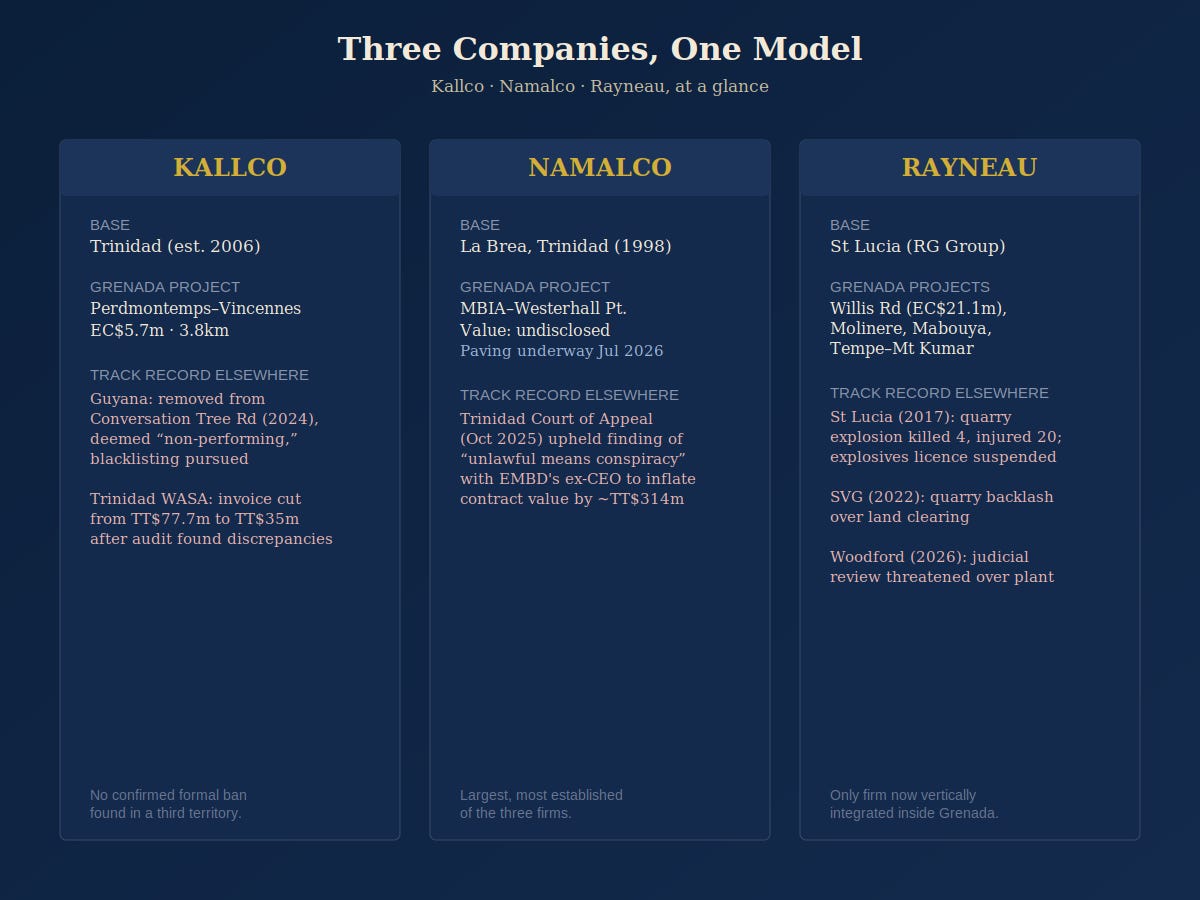
Kall Co Ltd was established in Trinidad in 2006 under the Kalloo family and grew over roughly two decades into one of the territory’s larger road and civil works contractors, with a long roster of paving, drainage, and flood-mitigation jobs across Trinidad’s housing developments and municipal roads.
Its record beyond Trinidad has been rockier. In 2024, Guyana’s Ministry of Public Works removed Kallco Guyana Inc from Lot 8B of the Conversation Tree Road Project, a roughly Guy$830-million contract to build a section of a larger Guy$1.8-billion four-lane highway and bridge project. After what the ministry called prolonged delays, government took possession of Kallco’s vehicles and equipment to recover an advance payment it had made, and reassigned the outstanding work to a Guyanese firm. Guyana’s Minister of Public Works, Juan Edghill, told local media the company had been deemed a ‘non-performing contractor’ and that the ministry intended to raise blacklisting with Guyana’s National Procurement and Tender Administration Board, adding pointedly that Kallco ‘should not be getting any other work.’
The company’s dealings with Trinidad’s own Water and Sewerage Authority were also contentious. WASA reduced a Kallco invoice from roughly TT$77.7 million to about TT$35 million after an external audit uncovered what it described as discrepancies in converting cubic metres of material to tonnes, along with inconsistencies in the asphalt thickness Kallco claimed to have laid. The dispute, over road-restoration work contracted between 2012 and 2015, was significant enough that Kallco pursued legal action against a television broadcaster over its coverage of the allegations.
None of this amounts to a documented, formal, region-wide ban on Kallco — no evidence surfaced in this investigation of the company being blacklisted in St Lucia, Antigua, or elsewhere. What is documented is narrower and still serious: a government minister publicly declaring the company non-performing and pursuing a formal blacklisting process in the same year it was doing business in the Caribbean, and a state utility finding that Kallco’s own invoices for materials supplied did not match what was actually delivered.
Company Two: Namalco — A Court Already Ruled on This
Namalco Construction Services, based in La Brea in southwest Trinidad since 1998, is by most measures the largest and most established of the three firms — a readymix concrete, aggregate, and heavy-infrastructure operation with a real regional footprint, including a joint venture with a Guyanese partner on the US$161-million Soesdyke-Linden Highway, one of Guyana’s largest road projects, funded by the Islamic Development Bank.
It is also the subject of one of the more damning pieces of case law involving a Caribbean road contractor in recent years. Namalco sued Trinidad’s Estate Management and Business Development Company (EMBD) for unpaid work on four infrastructure sites tied to housing for displaced Caroni sugar workers. EMBD countersued, arguing that Supplementary Agreements which had ballooned the value of two of those contracts by roughly TT$314 million were the product of a conspiracy between Namalco and EMBD’s then chief executive, who signed off on the increases despite having no authority to approve sums of that size.
A trial judge agreed, finding that the Supplementary Agreements were null and void and that the elements of an unlawful-means conspiracy to injure EMBD had been proven — including that Namalco knew its own counterpart at EMBD was acting without the authority to approve the deal. Trinidad’s Court of Appeal, in a ruling issued in October 2025, upheld the core of that finding, while sending back for recalculation the precise dollar figures owed. The net effect was to slash EMBD’s exposure on the contracts from roughly TT$1.3 billion in claimed value down to under TT$200 million once the inflated Supplementary Agreements were stripped out.
The Court of Appeal upheld findings of “the unlawful means conspiracy between mega contractor NAMALCO and the ex-Chief Executive” of a Trinidad state agency, used to inflate infrastructure contract values.
That ruling was still working its way through Trinidad’s courts when Grenada’s government confirmed it was finalising a Design-Build-Finance-Maintain package with Namalco for two of the country’s more strategic road corridors. A former senior Grenadian public officer has publicly urged the Mitchell administration to tread carefully given that history — a caution that, so far, does not appear to have altered the timeline of the deal.
Company Three: Rayneau — From Road Repair to Land Grab, According to Neighbours
Rayneau Construction Group is a St Lucia-based firm, part of the wider RG Group of Companies, that entered Grenada some years ago through the Molinere western main road reconstruction, a landslip-repair project on the Western Main Road Corridor that Grenada’s Ministry of Infrastructure had originally targeted for completion by December 2023. It never was, and parts of it remain unresolved to this day. According to the company’s own account, given by its CEO Rayneau Gajadhar in a May 2026 interview, the Molinere project exposed Rayneau to unreliable local supply of concrete and asphalt, a shortage it says forced it to bring in its own batching plant, trucks, pumps, and eventually its own asphalt plant, the plants that now anchor its ongoing, more contentious footprint in Woodford and Beausejour. What that account leaves out is that the road itself was never actually completed to standard. In March 2025, Prime Minister Mitchell told Parliament that a bridge forming part of the Molinere land-slippage repair still lacked a proper asphalt wearing surface, attributing the shortfall to a capacity issue at the local subcontractor responsible for supplying it and announcing that government would reopen the Telescope Quarry to source additional material. More than a year later, that subcontractor, CCCCI, confirmed in its own public statement that the surface on Molinere’s new concrete section still fell short of design standard.
The company whose market Rayneau’s new plants now encroach on is Consolidated Contractors Company Caribbean Inc (CCCCI), run by Grenadian businessman Nelson Louison and the country’s sole domestic producer of asphalt and quarry aggregate, drawing from the Mount Hartman quarry. CCCCI’s relationship to Rayneau is not simply that of a displaced competitor. On Molinere itself, CCCCI was Rayneau’s own paving subcontractor, hired to lay two contractually required layers of asphalt over the approaches to a new concrete section, on a base Rayneau had prepared, with payment for each layer contractually due in advance. In an April 2026 public statement of facts responding to the Prime Minister’s criticism of its performance, CCCCI said it never applied the second layer because Rayneau did not pay the sum due for it, and said the resulting substandard surface was also, separately, a product of what it called an improperly prepared base layer on Rayneau’s part. It is a rare case of one foreign-linked contractor publicly blaming another for the same defective stretch of road, with the Grenadian subcontractor caught in the middle.
CCCCI separately holds the roughly EC$16.5-million works contract for a different road entirely, commonly called the Cliff Road or Woburn/Cliff project, a 0.6-kilometre rehabilitation of the Eastern Main Road between the Springs/Woodlands junction and the Cliff/Woburn junction, not to be confused with either Molinere or the Cliff Junction to Maurice Bishop Highway project earmarked for Namalco. That contract price was itself the product of an informal side arrangement: CCCCI says it agreed to a roughly EC$3-million discount on the Cliff Road price in exchange for government’s promise to also award it two River Road contracts, an understanding that, as of CCCCI’s April 2026 statement, government had not yet honoured. CCCCI also disclosed that despite the Cliff Road job being about 90 percent complete, it had been paid only about EC$4 million of the contract’s value, roughly 25 percent. This dispute has its own history of public friction: in March 2025 budget debate, the Prime Minister told Parliament CCCCI had a capacity issue completing the road, then under a year old at the time, and by July 2025 government said it intended to terminate the contract outright over what it called a five-to-six-month delay. That termination did not ultimately proceed; the government’s own Ministry of Infrastructure, in a January 2026 project update, instead pushed the completion date back again while still attributing the slow pace chiefly to the contractor. By mid-April 2026, CCCCI itself reported the road was nearing completion and expected to be motorable within weeks. Taken together, the Cliff Road file shows a Prime Minister publicly faulting a local firm’s performance for over a year, a threatened termination that was quietly walked back, and a local contractor defending its workmanship while airing its own payment and side-deal grievances against the state.
Rayneau’s expansion beyond road repair and into industrial land use has drawn its own opposition, and by mid-2026 that opposition had moved from complaint to litigation. What is now called the Rayneau Development in Woodford, covering quarrying, an asphalt plant, concrete batching facilities, and a jetty in a coastal residential area, received partial planning approval through a General Development Order in December 2025, conditioned on the company preparing an Environmental and Social Management and Monitoring Plan and completing environmental assessment processes. The Woodford Environmental Alliance for Community Transformation says land clearance, road construction, and excavation began before those conditions were met and without a full Environmental Impact Assessment, citing damage that includes habitat loss near the endangered Grenada dove. In May 2026, the group, represented by the UK law firm Leigh Day and backed by the Fund for Global Human Rights’ Legal Empowerment Fund, sent a pre-action letter demanding disclosure of the relevant planning and environmental records, with judicial review proceedings to quash the approvals threatened if the response was unsatisfactory. Some residents separately allege a new access road Rayneau cut from the main road to the coast threatens historical sites nearby, including a boucan, an old mill, and an aqueduct dating to the plantation era; Rayneau’s chief engineer in Grenada has denied that a port is under construction, describing the coastal road instead as land-survey access. In Beausejour, residents have raised health concerns over emissions from Rayneau’s hot-mix asphalt plant, which a May 2026 public appeal placed roughly 143 metres from a playing field, within 300 metres of a pre-primary school, within 500 metres of a secondary school, and about 151 metres from a church, inside a populated residential area.
This is not the company’s first encounter with community and regulatory pushback in the region. In 2017, an explosion at a Rayneau quarry site in Cul-de-Sac, St Lucia, killed four people and injured twenty; a subsequent investigation by the United States’ Bureau of Alcohol, Tobacco, Firearms and Explosives found the blast followed welding work performed on a shipping container being used to store explosives, and the company’s explosives licence was suspended in the aftermath. In 2022, Rayneau faced backlash in St Vincent and the Grenadines over a quarry project in North Leeward, where residents accused the company of clearing land under active cultivation — including cocoa trees — to build access roads for stone mining, again without adequate consultation.
On the Ground, Mid-2026: Costs, Comebacks, and Who’s Actually Pouring Asphalt
Set against court filings and press releases, the more mundane paper trail of contract values and project updates tells its own story about what this model actually costs and how it plays out once the cameras leave the press conference.
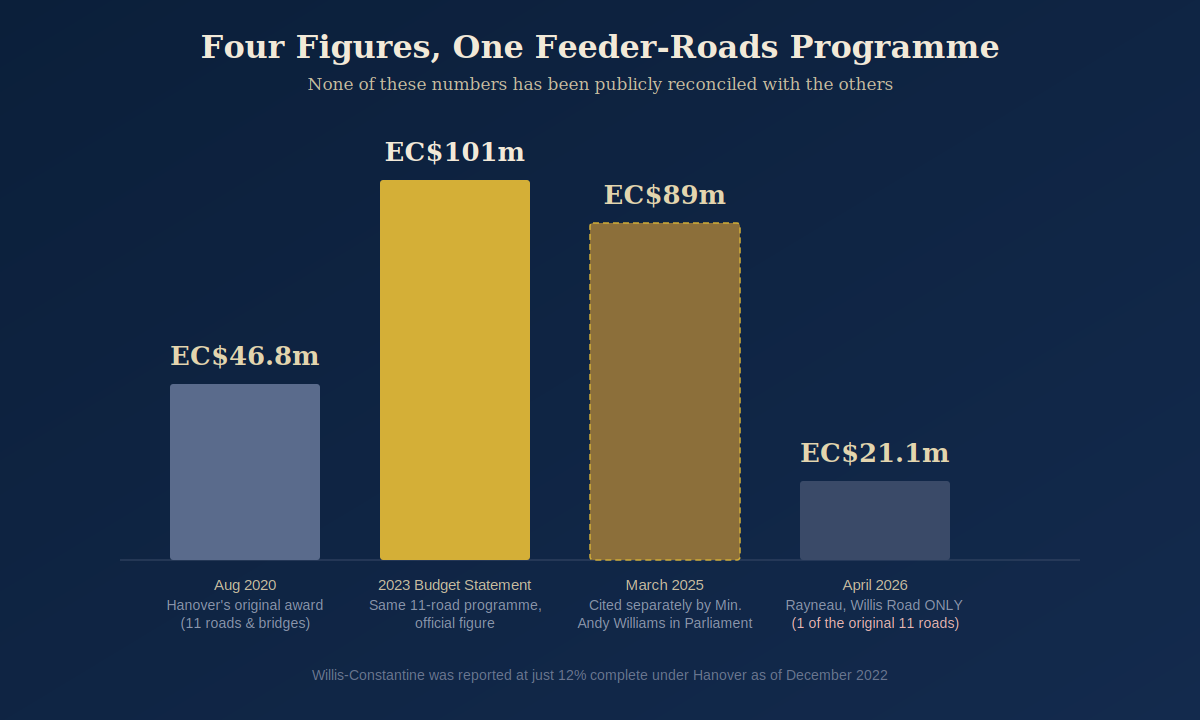
Take the Willis Road Rehabilitation Project, and take it carefully, because the public figures around it do not resolve as neatly as officials have suggested. In August 2020, Grenada’s Ministry of Infrastructure (prior administration) awarded Hanover Construction Company, a Trinidad-headquartered firm, an EC$46.8-million contract covering eleven roads and bridges under the Agriculture Feeder Roads Phase III programme, including Willis-Constantine. That EC$46.8 million was never the full programme cost, however: the government’s own 2020 Budget Speech, delivered around the same time, had already estimated the broader Phase III programme, roughly 44 kilometres of roads, bridges, and ancillary works, at approximately US$37.71 million, or about EC$100.62 million. By its 2023 Budget Speech, the current ( and new) administration was describing the same eleven-road portfolio as an EC$101-million project, and it disclosed specific completion percentages as of December 2022: La Borie at 46 percent, Baillies Bacolet to La Pastora at 20 percent, Clabony at 27 percent, Red Mud at 20 percent, and Willis-Constantine itself, where bridge abutment work had only just commenced, at 12 percent.
A separate April 2023 newspaper report, citing an unnamed former Chief Technical Officer, alleged that government had signed an addendum adding roughly EC$55 million specifically to Hanover’s contract, a jump the source described as close to the full value of the original award and, in his words, outside normal industry practice for a change order. No signed addendum, procurement board approval, or Cabinet decision confirming that figure has surfaced publicly, and the newspaper’s own account is ambiguous about whether the EC$55 million applied to La Borie alone or to the wider programme. What can be verified is only the arithmetic: EC$46.8 million plus EC$55 million comes to roughly EC$101.8 million, strikingly close to the EC$101-million figure the government was independently citing in its own budget documents around the same time. That resemblance does not prove the addendum claim; it only means the allegation is at least internally consistent with numbers the government itself later published.
“A man can’t bid for $50.00 and come back after the fact and say the project is $100.00.” — unnamed retired Chief Technical Officer, quoted by The New Today, April 2023
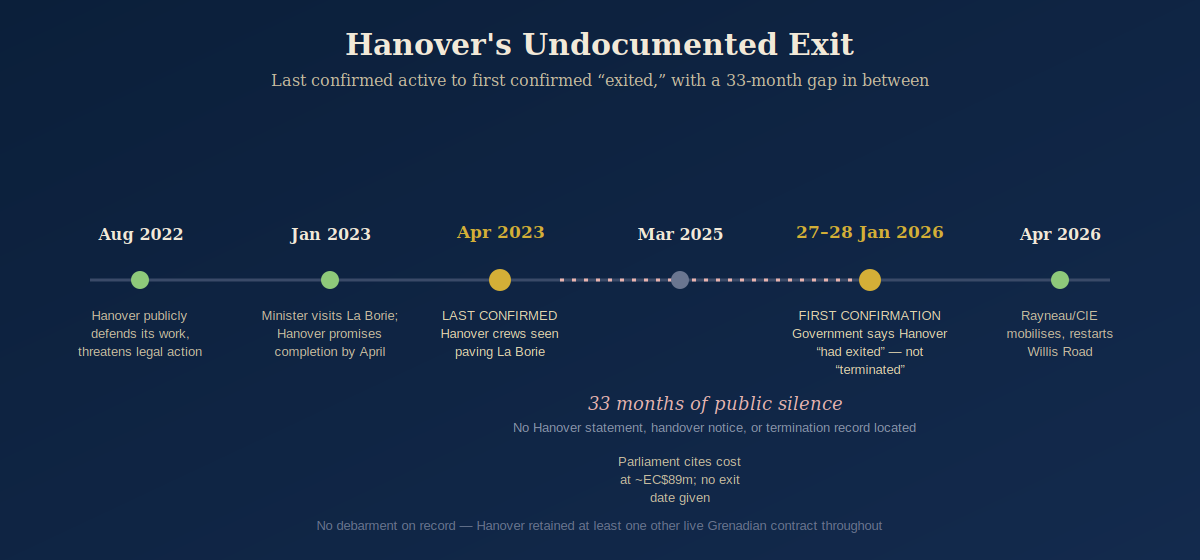
What happened to Hanover in the years between is documented only in fragments, and the fragments rule out a simpler story than a straightforward termination. Hanover was still publicly defending its Grenada work as late as August 2022, rejecting a minister’s criticism as false and misleading and threatening legal action against the newspaper that reported it, hardly the posture of a firm already on its way out. On 27 January 2023, Infrastructure Minister Dennis Cornwall visited the La Borie site, where Hanover’s own Director of Construction and Operations, Richard Maharaj, said the company hoped to finish the road by that April, following what officials described as a 2022 go-slow while the two sides reviewed the project. A 14 April 2023 report placed Hanover crews still paving La Borie, the last clear, dated public evidence located of the company actively working anywhere on the feeder-roads programme. After that date, the public record goes quiet. Government budgeted a further EC$7 million for the programme in 2024 without naming a contractor. During March 2025 budget debate, Minister Andy Williams cited the feeder-roads contract as having moved from roughly EC$46.8 million to approximately EC$89 million within six months, a third figure that does not cleanly reconcile with either the EC$101 million the 2023 Budget Statement had already used or the EC$55 million addendum alleged a year earlier, and he offered no exit date or termination ground for Hanover in the process. Only on 27 and 28 January 2026, in the same project update that described the collapsed local joint venture, did government publicly use the word that finally answered the question of Hanover’s fate: the company, officials said, had exited. Not terminated, not defaulted, not debarred, simply exited, a deliberately neutral word that leaves open whether the departure was Hanover’s own choice, a negotiated release, or a quiet non-renewal. Grenada’s Public Procurement Board has not listed Hanover among any debarred suppliers, and the company continued to hold at least one other live Grenadian contract, a CDB-financed rehabilitation and expansion of Bishop’s College awarded through competitive bidding in 2020, indicating this was a withdrawal from one troubled programme rather than a country-wide expulsion.
When work on Willis Road itself stalled further, the Ministry of Infrastructure first tried a local solution, brokering a joint venture among three Grenadian contractors to complete it. That arrangement collapsed the week the contract was to be signed, when the joint venture’s lead partner died. Rayneau, operating in Grenada as Construction and Industrial Equipment Limited, took over instead, on a project now priced at EC$21.1 million and targeted for completion by the fourth quarter of 2026.
It is tempting, and mathematically correct, to note that EC$21.1 million is about 45 percent of Hanover’s original EC$46.8-million award for all eleven roads combined, or, measured against the government’s later EC$101-million programme total, closer to 21 percent. Neither ratio is a fair like-for-like comparison, and presenting one without the other would be misleading. Willis-Constantine includes two major bridges and drainage works that make it disproportionately expensive next to a simple stretch of road; Hanover’s own price allocated specifically to Willis within the original EC$46.8-million package has never been published; how much Hanover was actually paid, how much of the bridge and drainage work it completed beyond the 12 percent reported in December 2022, and whether Rayneau’s EC$21.1 million includes correcting or demolishing defective prior work or building largely from scratch, are all questions the public record does not currently answer. What can be said with confidence is narrower, and in its own way more telling about transparency practices than any single scandal: the same eleven-road programme has now produced three different headline figures, EC$46.8 million, roughly EC$101 million, and EC$21.1 million for one remaining road, with no public accounting anywhere that reconciles them, and with government’s own chosen word for Hanover’s fate, exited, still undefined in any legal or financial sense a year after it was first used.
Kallco’s current Grenada job is smaller and more contained: an EC$5.7-million contract to repave roughly 3.8 kilometres of the Perdmontemps to Vincennes Road with hot-mix asphalt, running through scarifying and milling the old surface, laying two inches of new asphalt, and finishing with signage and pavement markings. Work began on 21 March 2026. Notably, the government has since described a hybrid arrangement on this stretch, with smaller local contractors handling civil works such as drainage and shoulder preparation while Kallco, as the larger firm, manages the asphalt paving itself, an approach that at least partially answers the Maroon Economics objection by keeping some of the contract value with Grenadian subcontractors rather than none of it.
The Namalco package is the largest of the three, and by late July 2026 it was no longer just a negotiation. As of 30 July 2026, NAMALCO Construction Services Limited crews were actively milling and paving a stretch of road near Maurice Bishop International Airport, work that only became visible on the ground roughly three months after the government’s April 2026 mobilisation announcement, itself already three months later than the January 2026 start Prime Minister Mitchell had projected the previous November. What is underway now, running from the airport area to the Sugar Mill Roundabout, is only the opening segment of a larger package covering two connected corridors: the road from Point Salines and MBIA through Cliff Junction and Woodlands toward the Maurice Bishop Highway, and separately the Eastern Main Road from Cliff Junction to Westerhall Point. The scope goes beyond resurfacing. Government and Namalco’s own project manager, Devon Rampasad, have described reconstructing drainage, installing reinforced-concrete drains and sidewalks, and stabilising the road base before paving, a sequence that, done properly, is meant to prevent the potholes and edge failures that follow when a road is simply paved over inadequate drainage. Rampasad has projected the finished corridor could last ten to fifteen years, a contractor’s own forecast rather than an independently verified engineering guarantee.
The award itself was not a single, unsolicited negotiation from the start. In November 2025, Prime Minister Mitchell said government had received Expressions of Interest for the Design-Build-Finance-Maintain packages from three large contractors: Namalco, Kallco (recorded in some government materials as CALCO), and Rayneau’s Grenada entity, Construction and Industrial Equipment Limited, the same three companies at the centre of this investigation. What followed that shortlist has not been made public in any form that allows outside scrutiny. No published contract value for the Namalco package has surfaced anywhere in the public record: not the construction price, not the total amount government will ultimately repay once financing charges are added, not a repayment schedule, not a priced Bill of Quantities, not a Procurement Board award notice showing how the three bids compared, not a performance-bond or defects-liability requirement, and not even a binding completion date. None of that absence proves procurement rules were broken. It does mean that, mid-way through a live construction project on some of Grenada’s most heavily travelled roads, the public still cannot independently check whether Namalco’s price represents value for money against what the other two shortlisted firms offered, or against what a conventionally financed, competitively tendered contract would have cost.
Rayneau, meanwhile, continues to expand its Grenada footprint well beyond Willis Road and the still-unresolved Molinere project, with separate government contracts for the Mabouya Landslip in St John and for the road network from Tempe to Mt Kumar in St George North-east.
“The challenge we have in Grenada with road repairs… is that we… up until recently, only had one local contractor… who could do asphalt work.” — PM Dickon Mitchell, on domestic capacity constraints
That admission cuts in an uncomfortable direction. The one local asphalt contractor Mitchell is almost certainly referring to is CCCCI, the same firm his own government has publicly criticised over the Cliff Road project, and the same firm now watching foreign primes build their own competing asphalt plants on the island. If Grenada genuinely had only one domestic asphalt producer until recently, the sole-sourcing threshold increase, the Design-Build-Finance-Maintain packages, and Rayneau’s vertically integrated plants were never just a matter of financing capacity; they were also a direct response to a domestic supply bottleneck sitting inside a single company, one the government has simultaneously depended on and disparaged in public over the same eighteen months.

The Government’s Own Defence — and Why It Cuts Both Ways
It would be dishonest to present this only as a story of a government freezing out its own people. Prime Minister Mitchell has made, publicly and repeatedly, an uncomfortable case against Grenada’s domestic contracting sector — one that deserves to be weighed on its own terms.
In December 2025 budget debate remarks, Mitchell told Parliament that many local contractors lack the collaborative capacity to bid on the scale of project now on offer, that some prefer to remain small rather than merge resources into larger, bondable entities, and that a number fail to file the tax returns and audited financial statements that financing institutions such as the Caribbean Development Bank require before releasing funds. He said that in some Expressions of Interest for Finance-Design-Build-Maintain projects, not a single Grenadian contractor was able to meet the qualifying criteria. He also warned sitting government contractors that continued underperformance — what he called shabby, improper, and delayed work — would carry consequences under their existing contracts.
“So for Contractors who have government contracts, deliver the people’s work, put resources on the site.” — PM Dickon Mitchell, addressing local contractors in Parliament
There is an internal tension in the government’s own position worth sitting with. Mitchell has separately criticised the previous administration for using grant and concessionary financing to ‘handpick and cherry-pick’ politically favoured local contractors who, he said, often did not deliver value for money. The current government’s Design-Build-Finance-Maintain arrangements are, functionally, a form of handpicking too — just aimed outward rather than inward, and justified by financing capacity rather than political convenience. Both critiques may be true at once: that some past local awards were poorly governed, and that the present foreign awards are being made with only partial visibility into the track record of the firms receiving them.

What Maroon Economics Says About a Road You Don’t Own
Under a Design-Build-Finance-Maintain structure, a contractor is not simply paid for concrete and labour. It is repaid, with the time value of money built in, for capital it fronted — capital that, in Kallco’s, Namalco’s, and Rayneau’s cases, sits with shareholders and lenders in Trinidad and St Lucia, not in Saint George’s. When that same contractor also builds its own concrete and asphalt plants on Grenadian soil, as Rayneau has done, it is not merely supplying its own project — it is displacing the market a Grenadian firm like CCCCI depends on to survive between government contracts. Every layer of the value chain — design, financing, aggregate, asphalt, plant and equipment — can, under this model, be captured by an entity whose profits, tax residency, and reinvestment decisions sit outside Grenada.

This is the leakage that CCCCI itself named in a separate public reflection on the construction sector: money that should circulate through local suppliers, wages, and small businesses instead flows out to external manufacturers, logistics networks, and remittances to a contractor’s home country, shrinking the secondary economic activity — retail, household spending, apprenticeship — that construction spending is supposed to generate domestically. A road financed, built, and later maintained by a foreign firm using foreign capital and, increasingly, foreign-controlled material supply, is a road that touches Grenada’s economy only briefly, at the moment the asphalt is laid, before the returns leave the island.
None of this requires believing that Kallco, Namalco, or Rayneau are uniquely bad actors in a region full of good ones. Construction is a hard, thin-margin, dispute-prone business everywhere, and Grenadian contractors are not immune to poor performance, as the Prime Minister’s own criticism of them makes clear. The point is narrower and more damning for a small government: Grenada appears to have gone looking for large-scale finance capacity outside its borders without first requiring, in the way many larger jurisdictions do, disclosure of a bidder’s litigation history, prior contract terminations, or blacklisting proceedings elsewhere in the region — the kind of due diligence that would have surfaced a live Guyanese non-performance finding on Kallco, an active Court of Appeal conspiracy ruling against Namalco, and a documented pattern of unconsulted industrial expansion by Rayneau, before any ink was on a page rather than after.

What Design-Build-Finance-Maintain Could Cost the Economy
Officially, the model Grenada is pursuing with Namalco and others is not just Design-Build-Finance; in the government’s own Expressions of Interest it is Design-Build-Finance-Maintain, or DBFM, with a maintenance obligation bolted on to the end of construction. That extra word matters more than it sounds like it should, and unpacking what DBFM actually does to a small state’s balance sheet, and to the flow of money through its economy, is worth doing on its own terms.
Start with the financing itself. When a private contractor fronts construction costs and government repays over time, that repayment carries the cost of money, the return the contractor and its lenders require for tying up capital and bearing construction risk before the state pays a cent. For a small sovereign like Grenada, that financing cost is very likely to exceed what the government could secure directly from concessional multilateral lenders such as the Caribbean Development Bank or the Islamic Development Bank, the same institutions Prime Minister Mitchell has said most local contractors cannot meet the qualifying criteria to work with. If that is true, the practical effect of DBFM is not that Grenada avoids paying financing costs on these roads; it is that Grenada pays financing costs to a private contractor’s balance sheet instead of to a concessional lender’s, at whatever premium the contractor and its own bankers have built into the deal. Government has not published the discount rate or effective financing cost embedded in any of the three companies’ packages, so the size of that premium, if one exists, is not something the public can currently see.
Then there is the question of where these obligations sit relative to Grenada’s own fiscal rules. The 2023 Fiscal Resilience Act caps public-private-partnership-related government liabilities at 5 percent of GDP and targets total public debt at no more than 60 percent of GDP, a framework the IMF has repeatedly credited with steering Grenada out of two prior debt restructurings. A DBFM repayment obligation functions economically like deferred debt service, a multi-year claim on future budgets, whether or not it is booked as conventional public debt. Nothing in the public record reviewed for this story shows how, or whether, the Namalco, Kallco, or Rayneau arrangements are being reported against the PPP cap or the debt target, and for a country with Grenada’s specific history of debt distress, that is not a small omission.
“Grenada is experiencing disaster-driven reconstruction spending, financed by short-term passport sales and long-term borrowing… This growth is the result of reconstruction after Hurricane Beryl… not due to structural productivity gains.” — Opposition Senator Norland Cox, responding to the 2026 budget
Cox’s critique, made in the same December 2025 budget debate where the Design-Build-Finance-Maintain model itself was being defended, was aimed at Grenada’s broader growth story rather than at these contracts specifically, but the two connect. Grenada’s post-Beryl recovery is running on a mix of reconstruction spending, government savings, and Citizenship-by-Investment revenue that the IMF itself has flagged as volatile and uncertain past the next few years. Layering new, multi-year DBFM repayment commitments on top of that base means committing future budgets, drawn from the same CBI-dependent revenue base Cox and the IMF both describe as unreliable, to service financing that was arguably more expensive than the concessional alternative in the first place.
The maintenance half of DBFM carries its own quieter cost. A contractor that also holds the maintenance contract captures not just the one-time construction spend but a recurring stream of resurfacing, drainage, and repair work for years afterward, work that would otherwise flow, in whole or in part, to Grenadian firms, equipment operators, and day labourers. Combined with Rayneau’s move to build its own concrete and asphalt plants rather than buy from CCCCI, and with no disclosed requirement that any of the three companies source materials or subcontract labour locally, the practical effect of DBFM as currently structured is to extend the period over which construction spending on Grenadian roads generates jobs and income outside Grenada, not just during the build but for years of maintenance after.
None of this means DBFM is indefensible. It does solve a real problem: it lets government commission large infrastructure without a large upfront capital outlay, at a moment when the state’s own balance sheet is still absorbing Hurricane Beryl reconstruction costs, and it shifts construction and completion risk onto the contractor rather than the taxpayer. Those are genuine, quantifiable benefits. The honest accounting question is whether they outweigh the financing premium, the fiscal-rule opacity, and the extended domestic leakage described above, and that is a question Grenada’s own public financial reporting does not yet let anyone outside government answer.
What Accountability Would Actually Look Like
A functioning procurement system does not need to ban foreign capital from Grenadian infrastructure — the island’s financing needs are real, and the Prime Minister’s underlying diagnosis of local contractor capacity is, in places, fair. But it should be able to answer basic questions before a contract is signed rather than after a road fails: what is this company’s default and dispute history across the region; is there a minimum percentage of local subcontracting, labour, and material sourcing built into the deal; and has the arrangement been reviewed by the Public Procurement Board with the same scrutiny applied to a EC$100,000 domestic tender, rather than negotiated as a package and announced at a press briefing.
Ground has already broken on the Cliff Junction to Maurice Bishop Highway package: Namalco crews were paving near MBIA by late July 2026, with the price Grenada is paying for that work still undisclosed. For that opening segment, the oversight window this report calls for has already closed. What remains open is whether the rest of the corridor, and the Eastern Main Road to Westerhall Point behind it, get a full public accounting before they are built, or whether they follow the same path CCCCI and Rayneau took on Molinere, where the base layer went down first and the public dispute over who was to blame for a road that still does not meet its own design standard came only after.
Sources & Further Reading
Guardian TT — WASA slashes Kallco bill by $44M — https://www.guardian.co.tt/news/wasa-slashes-kallco-bill-by-44m-6.2.1396908.51264ebf23
Trinidad Express — Kallco demobilised from Guyana road project — https://trinidadexpress.com/newsextra/kallco-demobilised-from-guyana-road-project/article_11ec762c-24b8-11ef-80d9-e7ca501c97d5.html
Stabroek News — Ministry took possession of Kallco’s vehicles, equipment — https://www.stabroeknews.com/2024/08/01/news/guyana/ministry-took-possession-of-kallcos-vehicles-equipment-to-cover-advance-payment-on-conversation-tree-project/
Project Calls — Kallco principals to meet Guyana minister — https://projectcalls.com/kallco-principals-to-meet-guyana-minister-today/
The New Today Grenada — Questions about TNT company to do work in G’da — https://www.thenewtodaygrenada.com/local-news/questions-about-tnt-company-to-do-work-in-gda/
Guardian TT — Court orders EMBD to pay Namalco $427m — https://www.guardian.co.tt/news/court-orders-embd-to-pay-namalco-427m-6.2.1485143.835735cb04
Kaieteur News — US$161M contract awarded for Soesdyke-Linden Highway — https://kaieteurnewsonline.com/2024/06/30/us161m-contract-awarded-to-guyanese-and-trinidadian-company-to-upgrade-soesdyke-linden-highway/
The New Today Grenada — Rayneau Construction faces mounting opposition — https://www.thenewtodaygrenada.com/local-news/rayneau-construction-faces-mounting-opposition-over-projects-in-grenada/
NOW Grenada — Statement of facts, CCCCI construction — https://nowgrenada.com/2026/04/statement-of-facts-cccci-construction/
NOW Grenada — People empowerment through construction (CCCCI) — https://nowgrenada.com/2026/06/people-empowerment-through-construction/
The New Today Grenada — Local contractors in trouble — https://www.thenewtodaygrenada.com/local-news/local-contractors-in-trouble/
NOW Grenada — Infrastructure Ministry will terminate contracts that violate agreements — https://nowgrenada.com/2025/12/infrastructure-ministry-will-terminate-contracts-that-violate-agreements/
The New Today Grenada — Dickon Mitchell accused Keith Mitchell of political grandstanding — https://www.thenewtodaygrenada.com/local-news/dickon-mitchell-accused-keith-mitchell-of-political-grandstanding/
Central Procurement Unit, Government of Grenada — procurement.gd —
https://www.procurement.gd/
Public Procurement and Disposal of Public Property Act, 2014 (Grenada) — http://www.oas.org/juridico/PDFs/mesicic5_grd_leganddocs_publicproc.pdf
NOW Grenada — Sole sourcing threshold to increase to EC$100,000 — https://nowgrenada.com/2024/01/sole-sourcing-threshold-to-increase-to-ec100000/
NOW Grenada — Government increases single sourcing procurement threshold — https://nowgrenada.com/2024/04/government-increases-single-sourcing-procurement-threshold/
The New Today Grenada — Update on several multi-million Road Rehabilitation Project — https://www.thenewtodaygrenada.com/local-news/update-on-several-multi-million-road-rehabilitation-project/
NOW Grenada — Minister of Infrastructure’s update of projects — https://nowgrenada.com/2026/01/minister-of-infrastructures-update-of-projects/
NOW Grenada — Progress and delays across major infrastructure projects — https://nowgrenada.com/2026/04/progress-and-delays-across-major-infrastructure-projects/
NOW Grenada — Grenada agriculture feeder roads to commence in August 2020 — https://nowgrenada.com/2020/08/grenada-agriculture-feeder-roads-to-commence-in-august-2020/
Government of Grenada — 2020 Budget Speech (Agriculture Feeder Roads Phase III) — https://www.finance.gd/docs/2020BudgetSpeech.pdf
Government of Grenada — 2023 Budget Statement (Feeder Roads Phase III completion percentages) — https://www.finance.gd/docs/2023/2023-Budget-Speech.pdf
Grenada Parliament — Hansard, House of Representatives Budget Presentation and Debate, March 2025 (Hon. Andy Williams) — https://grenadaparliament.gd/wp-content/uploads/2026/03/HOR-BUDGET-PRESENTATION-AND-DEBATE-2025.pdf
Government Information Service, Grenada — NAMALCO to upgrade infrastructure from MBIA to Westerhall Point — https://www.facebook.com/gisgrenada/posts/namalco-to-upgrade-infrastructure-from-mbia-to-westerhall-point/1358417606479982/
The New Today Grenada — Gov’t cited for signing Addendum with Hanover Construction — https://www.thenewtodaygrenada.com/local-news/govt-cited-for-signing-addendum-with-hanover-construction/
The New Today Grenada — The signed contract for the Woburn/Cliff road project — https://www.thenewtodaygrenada.com/local-news/the-signed-contract-for-the-woburn-cliff-road-project/
Leigh Day — Grenada community group considers legal action over Woodford’s Rayneau Development — https://www.leighday.co.uk/news/press-releases/2026-news/grenada-community-group-considers-legal-action-over-woodford-s-rayneau-development/
NOW Grenada — Consider our people (Beausejour plant proximity concerns) — https://nowgrenada.com/2026/05/consider-our-people/
Rayneau Group of Companies — CEO Rayneau Gajadhar interview, May 2026 —
https://rayneau.blogspot.com/
NOW Grenada — Molinere land slippage first fix under Western Main Road Project — https://nowgrenada.com/2021/11/molinere-land-slippage-first-fix-under-western-main-road-project/
The New Today Grenada — PM Dickon Mitchell reads the riot act — https://www.thenewtodaygrenada.com/local-news/pm-dickon-mitchell-reads-the-riot-act/
The New Today Grenada — Gov’t moving to fire Louison firm from Woburn/Cliff road project — https://www.thenewtodaygrenada.com/local-news/govt-moving-to-fire-louison-firm-from-woburn-cliff-road-project/
The New Today Grenada — $12 million to complete Molinere land slippage — https://www.thenewtodaygrenada.com/local-news/12-million-to-complete-molinere-land-slippage/
NOW Grenada — Why Grenada must strengthen public infrastructure oversight — https://nowgrenada.com/2026/07/why-grenada-must-strengthen-public-infrastructure-oversight/
NOW Grenada — Cox: 2026 Budget not forward-looking financial plan — https://nowgrenada.com/2025/12/cox-2026-budget-not-forward-looking-financial-plan/
World Bank/IMF — Grenada Joint Bank-Fund Debt Sustainability Analysis — https://documents1.worldbank.org/curated/en/099042325160022282/pdf/BOSIB-5bee1242-8a19-41fb-b808-e55651fef75b.pdf
Government of Grenada — RGSM Prospectus 2024-2026 (Fiscal Resilience Act, PPP liability cap) — https://www.ecseonline.com/wp-content/uploads/2024/01/ECCBLIB-1290161-v1-Approved_-_Gov_t_of_Grenada_RGSM_Prospectus_2024.pdf
Mayberry Investments — Grenada’s Fiscal Measures and Debt Sustainability (IMF Article IV summary) — https://www.mayberryinv.com/grenadas-fiscal-measures-and-debt-sustainability/
This report relies on court rulings, government statements, and reporting from Caribbean news outlets cited above; readers are encouraged to consult primary sources directly.