

SUNSET IN THE CRESCENT
How Iran, China, and Russia Are Expelling the United States from the Middle East— and Why the Caribbean Is Now the New Front Line

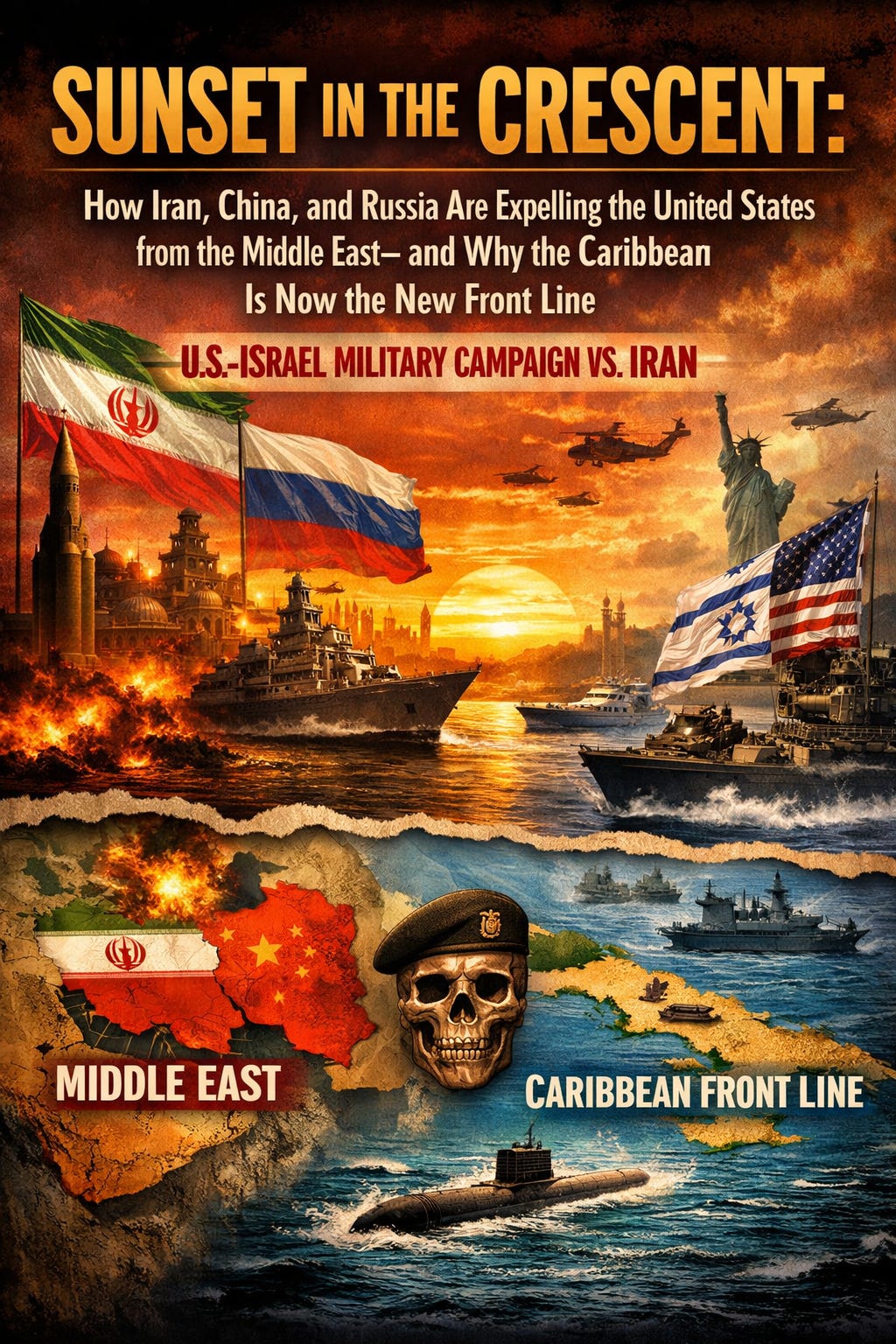
[ U.S.-Israel Military Campaign vs. Iran ]
An investigative analysis of American strategic collapse under fire, the war that is rewriting the Middle Eastern order, and the quiet dismemberment of Caribbean sovereignty as Washington scrambles to compensate.
An Empire Under Fire
There is a particular silence that precedes imperial withdrawal. It is not the silence of peace, but the silence of recalculation — of an overextended power quietly folding its flags in one theatre while making ferocious noise in another. That silence, once a matter of strategic prognosis, has now been replaced by something louder and more consequential: the sound of missiles impacting American military bases across the Gulf, the crackle of burning radar installations, and the controlled fury of an Iranian foreign minister who — in a remarkable interview that Western legacy media has largely refused to cover with accuracy — declared not merely that his country would not negotiate with the United States, but that it welcomed the possibility of an American ground invasion as an opportunity rather than a threat.
The United States and Israel are now engaged in active military conflict with Iran. What began as a campaign of assassinations, sanctions, and proxy containment has escalated into something that strategic analysts a decade ago would have considered unthinkable: a direct, kinetic confrontation between the world’s most powerful military alliance and a regional power that has spent forty years preparing for exactly this war. And by every honest assessment of the battlefield evidence — stripped of the triumphalist framing of American cable news and the Israeli government’s press operation — Iran is not losing.
Against this backdrop of active conflict and accelerating American military humiliation in the Gulf, Washington has turned its gaze southward with a desperation that is now barely concealed. The Caribbean and Latin America — long treated as America’s strategic backyard — are being reconfigured, rapidly and ruthlessly, as a compensatory zone of hemispheric dominance. At the centre of that reconfiguration sits the Caribbean Community, CARICOM, and the two nations that give it its institutional spine: Guyana, home of the CARICOM Secretariat, and Trinidad and Tobago, where the Treaty of Chaguaramas was signed in 1973.
Iran’s foreign minister did not warn America. He invited it. That distinction — between a power that fears confrontation and one that has weaponised it — tells you everything about who is winning this war.
The War That Western Media Will Not Accurately Report
Iran’s Strategic Posture: Invitation, Not Deterrence
In a signal interview that received scant serious analysis in Western mainstream outlets — outlets that Iranian officials and their regional allies have openly characterised as instruments of American state narrative management rather than independent journalism — Iran’s Foreign Minister articulated a strategic posture of extraordinary confidence. He rejected any negotiations with the United States as a matter of principle, not pragmatism. More striking still, when asked about the prospect of an American ground invasion of Iran, he did not issue warnings or threats. He welcomed it.
Full interview here: Special Report: NBC News exclusive interview with Iran’s foreign minister on war with U.S.
This is not the rhetoric of a cornered regime. It is the calculated communication of a military establishment that has spent four decades war-gaming precisely this scenario and believes, with evidence, that it holds the advantage. The Foreign Minister’s dismissal of U.S. and Israeli military planners as strategically incompetent — a charge he grounded not in ideology but in the documented record of their operational failures — represents a threshold shift in Iranian public posture. Tehran is no longer performing deterrence. It is performing confidence, which is a more dangerous thing entirely.
FIELD ASSESSMENT: Iranian drone and missile strikes have targeted and degraded U.S. radar installations, oil refineries, and command-and-control infrastructure across multiple Gulf sites. Patriot air defense batteries have been tested beyond their operational parameters. American force projection capacity in the region is measurably diminished.
The military record supports the confidence. Iranian precision strikes — deploying layered combinations of ballistic missiles, cruise missiles, and one-way attack drones — have struck American bases across the Gulf with a accuracy that has exposed critical vulnerabilities in U.S. air defence architecture. Patriot systems, the flagship of American terminal defence and the product sold to Gulf monarchies at extraordinary profit as a guarantee of security, have been saturated, spoofed, and in several documented instances, defeated. Radar installations have been destroyed. Refinery infrastructure in Gulf states has been struck. Command-and-control nodes have been degraded.
Western media has reported these strikes through a frame of Iranian ‘aggression’ and American ‘response,’ systematically understating the operational damage inflicted and overstating the effectiveness of American countermeasures. Independent military analysts, drawing on satellite imagery, flight tracking data, and the testimony of Gulf-based sources, present a starkly different picture: one of a U.S. military presence that is under sustained, effective attrition, losing capability faster than it can be replaced, and whose deterrence credibility among regional actors is in free fall.
The Assassination Calculus: Backfire as Strategic Outcome
The American and Israeli strategy of targeted assassination — of Iranian commanders, nuclear scientists, and Axis of Resistance leaders — was predicated on a theory of decapitation: remove enough leadership nodes and the system collapses. The empirical record has demolished this theory, and the Iranian Foreign Minister stated so directly and at length. The assassination of General Qassem Soleimani in January 2020, carried out on the direct order of President Trump, was the signature act of this strategy. It produced the opposite of its intended effect.
Rather than demoralising the Iranian security establishment, Soleimani’s killing unified Iranian society across political and ethnic lines to a degree that the Islamic Republic had not achieved since the 1980-88 war with Iraq. It produced a parliamentary vote of unified condemnation that included the rare spectacle of reformist and hardline legislators in open solidarity. It elevated Soleimani from effective commander to national martyr, a transformation that gave his legacy — and the strategic framework he had built across the Axis of Resistance — a permanence that a living general could never have achieved. Within seventy-two hours, Iran had launched ballistic missile strikes against American bases in Iraq, inflicting documented traumatic brain injuries on over one hundred American service members in an attack the Trump administration initially characterised as causing ‘no casualties’ — a lie so transparent that it was subsequently retracted.
Subsequent assassinations — of nuclear scientists, of Hamas political leadership, of Hezbollah commanders — have followed the same pattern: short-term tactical disruption, long-term strategic backfire. Each killing confirms, for the Iranian population and the broader Axis of Resistance, the narrative that America and Israel are engaged in a war of annihilation against Iranian civilisation, not merely Iranian foreign policy. Nothing recruits more effectively than a martyr. Nothing consolidates a regime more effectively than a foreign enemy that behaves exactly as the regime said it would.
Every assassination Washington ordered was meant to break Iranian resolve. Each one instead became a founding document of Iranian unity — and proof that U.S. intelligence understood the country it was trying to destroy far less than it believed.

The Strait of Hormuz: The Choke Point That Changes Everything
No single geographical feature concentrates American strategic vulnerability in the current conflict more precisely than the Strait of Hormuz — the narrow waterway through which approximately twenty percent of global oil supply transits daily. Iranian military doctrine has long identified Hormuz as its ultimate deterrent: the ability to close, or credibly threaten to close, a passage whose obstruction would send global energy prices into a spiral that would damage the American and European economies far more than any sanctions regime damages Iran’s.
