

THE GREEN EMPIRE
How Western Powers Weaponized Climate Change to Execute the Greatest Resource Heist in Modern History

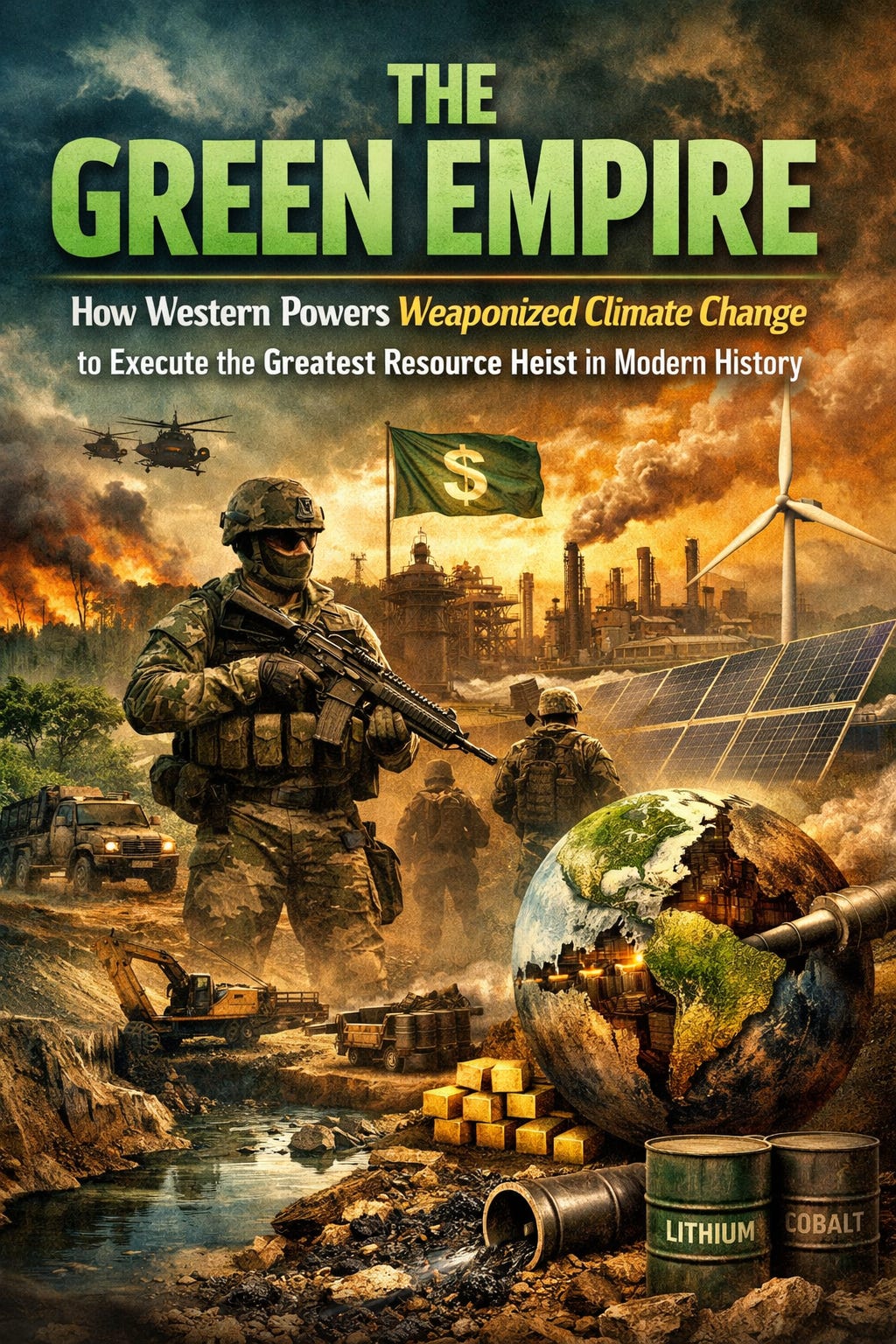
The Systematic Destruction of Energy Sovereignty Through Renewable Energy Coercion, Debt Colonialism, and Military Force
An Investigation into How the Climate Agenda Became a Trojan Horse for Neo-Imperial Control—and Why Nations That Resisted Met Sanctions, Destabilization, and Invasion
THE PROMISE AND THE TRAP
In the opening years of the 21st century, a seductive narrative swept across international development forums, climate conferences, and the boardrooms of multilateral banks. The message was clear, urgent, and morally compelling: the world must transition away from fossil fuels to save the planet from catastrophic climate change. For developing nations—many of them rich in oil and gas but poor in capital and technology—the promise seemed revolutionary.
Break free from the volatility of global oil markets. Escape the resource curse. Build energy independence through solar panels and wind turbines. Join the community of responsible nations committed to a sustainable future.
What wasn’t said—what couldn’t be said in polite company at COP summits or World Bank briefings—was that this transition was being structured not as liberation, but as the most sophisticated resource capture mechanism since formal colonialism ended.
This investigation reveals how the renewable energy agenda, while genuinely motivated by climate concerns among many of its advocates, was systematically weaponized by Western powers—primarily the United States—to strip resource-rich nations of energy sovereignty, redirect global energy flows through Western-controlled financial and technological chokepoints, and when necessary, deploy sanctions and military force against those who refused to comply.
The evidence suggests a pattern so consistent, so geographically widespread, and so aligned with traditional great power competition that it demands we reconsider the entire narrative of the “clean energy transition.”
PART I: THE ARCHITECTURE OF SURRENDER
The Climate Finance Trap
The mechanism was elegant in its simplicity. Western nations and institutions created a global architecture where climate compliance became the gateway to economic survival.
Between 2015 and 2025, over 150 developing nations signed Paris Agreement commitments that explicitly required them to submit Nationally Determined Contributions (NDCs)—essentially promises to reduce emissions and transition away from fossil fuels. These weren’t merely aspirational goals. They became contractual obligations tied to access to:
World Bank development loans (which increasingly included climate conditionality clauses)
IMF structural adjustment programs (which began penalizing fossil fuel subsidies while encouraging renewable investments)
European Union trade agreements (which implemented carbon border adjustment mechanisms that effectively taxed imports from non-compliant nations)
U.S. bilateral aid packages (which after 2021 explicitly prohibited funding for fossil fuel projects abroad)
According to data compiled by the International Institute for Sustainable Development, between 2015 and 2024, at least 73 oil and gas-producing developing nations faced direct pressure to curtail hydrocarbon exploration as a condition of receiving climate finance. These nations collectively represented approximately 2.8 trillion barrels of oil equivalent in proven and probable reserves—roughly 45% of global remaining conventional resources outside of OPEC’s core members and Russia.
The financial pressure was immense. Nigeria, which derives 70% of government revenue from oil, was offered $20 billion in climate finance through various mechanisms—but only if it agreed to phase out gas flaring, limit new offshore exploration, and redirect its energy investments toward renewables. Angola faced similar conditions for approximately $12 billion in World Bank and bilateral assistance.
The Technology Dependency Trap
But the surrender of fossil fuel development was only the first mechanism. The second was more insidious: the creation of permanent technological dependency.
Renewable energy infrastructure—solar panels, wind turbines, battery storage systems, smart grid technology—requires sophisticated manufacturing capabilities, rare earth minerals processing, and intellectual property that remain overwhelmingly concentrated in a handful of nations.
As of 2024, according to the International Energy Agency:
China controls approximately 80% of global solar panel manufacturing capacity
The United States and European Union control roughly 90% of advanced wind turbine patents
Three companies—Tesla (U.S.), CATL (China), and LG Energy (South Korea)—control 65% of global battery production capacity
Rare earth mineral processing, essential for renewable technologies, is 85% controlled by China, with secondary processing concentrated in Malaysia and Vietnam under Chinese joint ventures
What this means in practice: a nation that abandons its oil sector to embrace renewables doesn’t achieve energy independence. It trades one form of dependency—on global oil markets where it at least possessed the underlying resource—for another form where it owns neither the resource, the technology, nor the manufacturing capacity.
Egypt provides a stark illustration. Under intense pressure to meet climate commitments and facing restrictions on international financing for its substantial natural gas reserves, Cairo committed to generating 42% of its electricity from renewables by 2035. The result: over $15 billion in contracts awarded to Siemens (Germany), ACWA Power (Saudi Arabia, but using Western technology), and Scatec (Norway). Egypt now faces long-term debt obligations for technology it doesn’t control, producing energy at rates substantially higher than what its own gas reserves could provide, with maintenance and replacement dependent on foreign supply chains.
The Just Energy Transition Partnerships: Sovereignty for Sale
Perhaps no mechanism illustrates the systematic nature of this transfer more clearly than the Just Energy Transition Partnerships (JETPs), launched with great fanfare at COP26 in Glasgow.
South Africa was the first test case—and the model is revealing. In exchange for $8.5 billion in climate finance from the United States, European Union, United Kingdom, France, and Germany, Pretoria agreed to:
Decommission coal plants representing 35% of generating capacity
Cancel planned coal and gas expansions despite having substantial domestic reserves
Restructure the state utility Eskom to accept private and foreign investment
Prioritize renewable energy zones that would require foreign technology and financing
The devil resided in the details. Of the $8.5 billion pledged, only $3.7 billion was in grants—the remainder was concessional loans. The financing came with requirements that contracts be open to international competitive bidding, effectively favoring firms with existing renewable technology portfolios: primarily European and American companies, with Chinese firms notably restricted through “trusted vendor” clauses.
South Africa, which has platinum reserves, coal reserves, and the industrial capacity to potentially develop its own energy infrastructure, instead became a client state in the renewable economy—dependent on foreign capital, foreign technology, and foreign expertise to meet climate targets that were themselves externally imposed.
Indonesia, Vietnam, and Senegal have since signed similar JETPs. The pattern repeats: fossil fuel curtailment in exchange for renewable financing that creates permanent technological and financial dependency.
PART II: THE AMERICAN ENERGY PARADOX
Drilling While Preaching
While the renewable energy agenda was being exported through climate diplomacy, something remarkable was happening within U.S. borders: an unprecedented expansion of fossil fuel production.
According to U.S. Energy Information Administration data:
U.S. crude oil production increased from 5.7 million barrels per day in 2011 to over 13.2 million barrels per day by 2024—making America the world’s largest oil producer
Natural gas production surged from 23 trillion cubic feet in 2011 to over 37 trillion cubic feet by 2024
Liquefied natural gas (LNG) exports grew from virtually zero in 2015 to over 12 billion cubic feet per day by 2024, making the U.S. the world’s largest LNG exporter
This expansion occurred across Democratic and Republican administrations alike. While President Obama championed the Paris Agreement, his administration oversaw the fracking revolution. President Trump openly rejected climate multilateralism while production continued to climb. President Biden, despite campaign promises to “end fossil fuels,” approved the Willow Project in Alaska and expanded LNG export terminal permits at a record pace.
The messaging to developing nations was clear: “Do as we say, not as we do.”
But the apparent hypocrisy concealed a strategic logic. By encouraging other nations to constrain their fossil fuel development while maximizing American production, the United States was positioning itself to capture global market share in the very sector it was publicly disparaging.
The LNG Geopolitical Weapon
The strategic value of this approach became crystalline clear following Russia’s invasion of Ukraine in February 2022.
When European nations, which had become dangerously dependent on Russian natural gas, needed an alternative supplier, it was the United States that stepped into the breach. American LNG exports to Europe increased by over 150% between 2021 and 2023. Long-term contracts were signed that will lock European energy markets into American supply chains for decades.
This wasn’t merely opportunism—it was the culmination of a strategy years in the making. Internal State Department documents from 2014-2015, revealed through FOIA requests, show explicit discussions of using American energy production to “reduce European dependence on Russian energy” and create “strategic leverage through energy interdependence.”
The renewable energy agenda served this strategy perfectly. By encouraging European allies to phase out domestic fossil fuel production (North Sea oil, German coal) while delaying the full renewable transition (which remains decades away from meeting baseline energy demand), the U.S. created a dependency gap that American LNG filled.
Nations like Algeria, Nigeria, and Mozambique—which possess substantial natural gas reserves that could have supplied European markets—faced restrictions on developing these resources through climate financing conditionalities. The result: energy that could have flowed from African nations to European markets at lower cost and shorter distance instead flows from Texas and Louisiana across the Atlantic, generating profits for American firms and geopolitical leverage for Washington.
The Renewables Industrial Complex
But the American strategy wasn’t limited to fossil fuels. Recognizing that renewable technology would eventually dominate global energy markets, the U.S. positioned itself to control the commanding heights of this sector as well.
The Inflation Reduction Act of 2022, despite its climate-focused branding, was primarily an industrial policy bill that deployed $369 billion in subsidies to ensure American dominance in renewable technology manufacturing, battery production, and clean energy supply chains.
Crucially, these subsidies included “domestic content” requirements and restrictions on Chinese technology—effectively creating a Western-controlled renewable supply chain parallel to the Chinese-dominated one. Nations receiving U.S. climate finance or participating in American-backed renewable projects face pressure to source technology from this Western supply chain, even when Chinese alternatives are substantially cheaper.
The result: whether developing nations choose fossil fuels or renewables, the infrastructure increasingly flows through American-controlled or American-allied channels.
PART III: WHEN NATIONS RESISTED—THE RETURN OF FORCE
The elegant system of climate finance conditionality, technological dependency, and market capture worked smoothly for nations that accepted the terms. But what happened to those that refused? What happened to leaders who insisted on energy sovereignty, who pursued independent development of their hydrocarbon resources, who built alliances outside the Washington-Brussels axis?
History provides a clear and chilling answer: they faced economic strangulation, political destabilization, and in extreme cases, military intervention.
Venezuela: Sanctions, Seizure, and the Ultimate Intervention
Venezuela’s case represents perhaps the most dramatic example of how resistance to externally guided energy policy escalates to direct force.
Under Hugo Chávez (1999-2013) and his successor Nicolás Maduro, Venezuela pursued an explicitly anti-imperialist energy policy. Despite possessing the world’s largest proven oil reserves—over 300 billion barrels—Caracas refused to fully open its energy sector to American firms, instead cultivating partnerships with Russia, China, Cuba, and Iran. Venezuelan oil revenues funded social programs domestically and subsidized energy for allied nations throughout Latin America and the Caribbean through the Petrocaribe initiative.
For Washington, this represented an unacceptable challenge. A resource-rich nation operating outside American geopolitical control, using energy wealth to build an alternative pole of influence in the Western Hemisphere, contradicted fundamental U.S. strategic doctrine.
The response was systematic:
Phase 1: Economic Warfare (2015-2019)
Targeted sanctions against PDVSA (Venezuela’s state oil company)
Financial sanctions preventing Venezuela from accessing U.S. dollar transactions
Pressure on international banks to refuse Venezuelan accounts
Seizure of Venezuelan assets abroad, including Citgo Petroleum’s U.S. operations
These sanctions, which the UN Special Rapporteur on Unilateral Coercive Measures described as potentially constituting “crimes against humanity” due to their impact on civilians, devastated Venezuela’s economy. Oil production collapsed from 2.5 million barrels per day in 2015 to under 500,000 by 2020—not because the oil disappeared, but because Venezuela was systematically denied access to the global financial system, spare parts, and technical services necessary for production.
Phase 2: Political Destabilization (2019-2023)
Recognition of opposition figure Juan Guaidó as “interim president”
Attempts to redirect Venezuelan oil revenues to Guaidó’s parallel government
Support for military defections and coup attempts
Comprehensive oil embargo aimed at complete economic collapse
Phase 3: Direct Military Action (2026) In January 2026, the United States executed a military operation that resulted in the capture of President Nicolás Maduro. The operation was publicly justified on grounds of “drug trafficking” and “humanitarian intervention,” but the timing and aftermath revealed different priorities.
Within weeks of Maduro’s capture, U.S. officials began discussions with Venezuelan opposition figures about restructuring PDVSA, reopening the oil sector to American investment, and unwinding Venezuelan energy partnerships with China and Russia. European energy companies that had maintained limited operations under sanctions, such as Eni and Repsol, found themselves further sidelined as Washington prioritized American firms—Chevron, ExxonMobil, and ConocoPhillips—for renewed contracts.
A senior State Department official, speaking to Bloomberg on condition of anonymity, described the post-Maduro transition as “beneficial to global energy markets” because it would “restore market-based governance” to Venezuelan reserves—a euphemism for placing them under Western, primarily American, control.
The message to other resource-rich nations was unmistakable: persistent resistance to American energy prerogatives, even by a sovereign nation developing its own resources, would ultimately be met with force.
Libya: The Destruction of Energy Sovereignty
If Venezuela represents ongoing escalation, Libya demonstrates the complete destruction of an independent energy power.
