

When the World Catches Fire
The Caribbean at the Edge of a New World Order

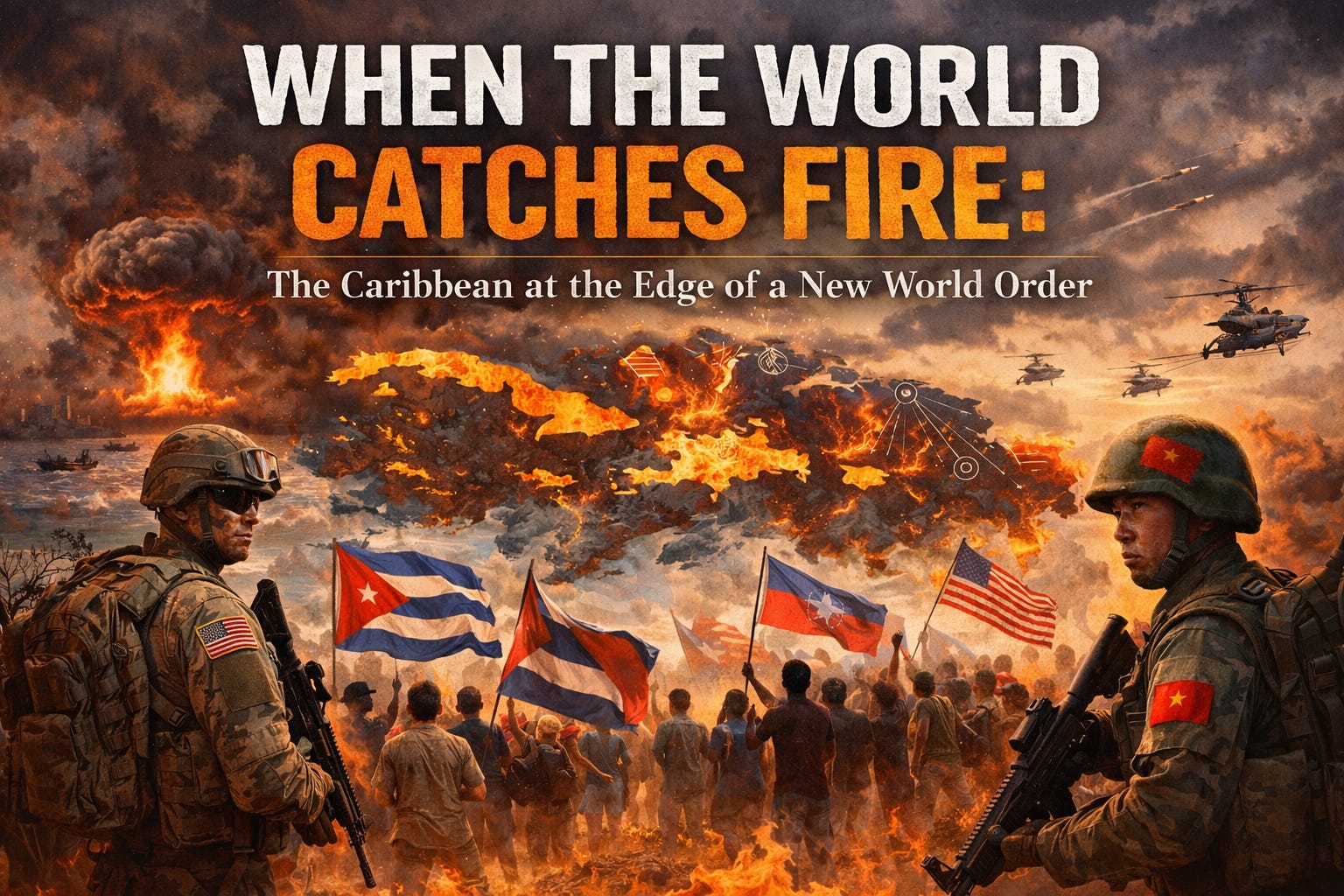
From a 21-mile strait in the Persian Gulf to the blockaded streets of Havana — one war is redrawing the map of power, and the Caribbean stands in the trembling middle of it all.
Everything Connects
The world’s crises do not arrive separately. They arrive as a flood.
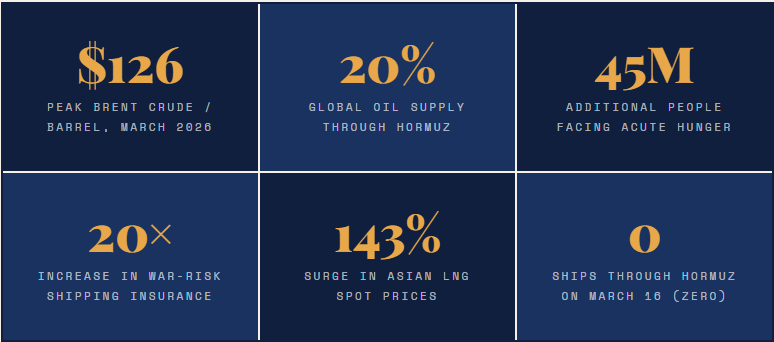
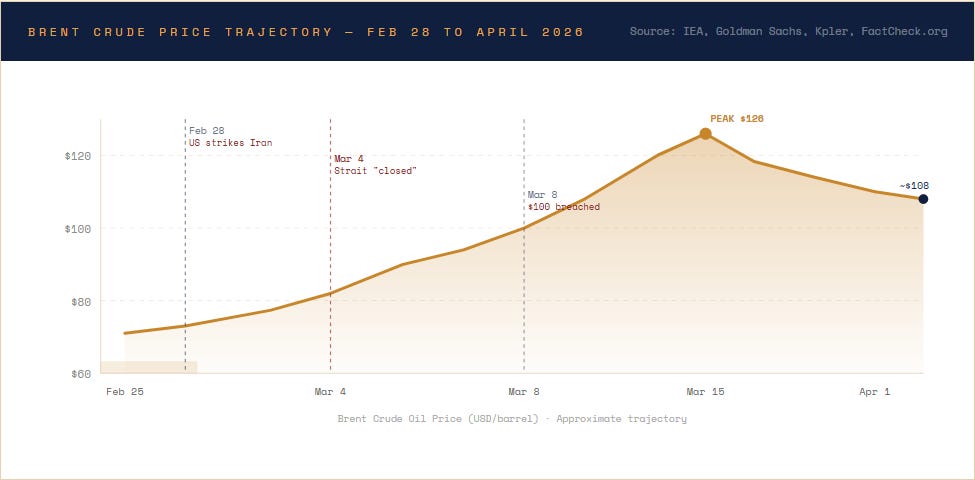
There is a moment — most people miss it — when the news stops being a collection of separate stories and reveals itself to be a single narrative. We are living through that moment now. A war ignited in the Persian Gulf in the final days of February 2026. Oil surged past $126 a barrel. A narrow 21-mile chokepoint — the Strait of Hormuz — swallowed 20 percent of the world’s daily oil supply and held it hostage. Fertilizer prices spiked. Shipping costs tripled. Forty-five million additional human beings were pushed toward acute hunger. Supermarket shelves across the Gulf emptied. Cruise ships, with fifteen thousand passengers aboard, were stranded between one world and another.
And yet, in the offices of governments in Washington, Tel Aviv, and Moscow, all of this was calculated — planned for, anticipated, even desired. The chaos was not a bug. It was the architecture of a new world order being violently assembled over the ruins of the old one.
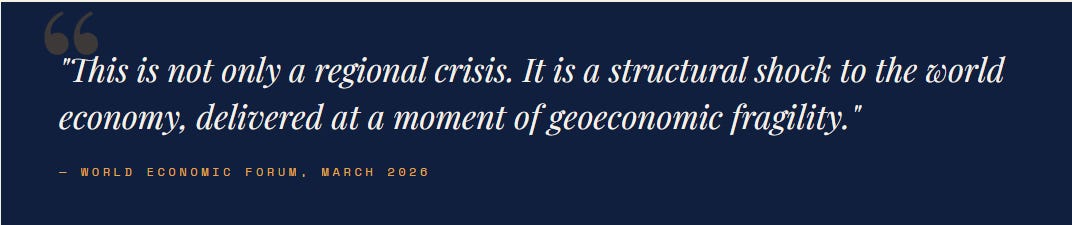
For the Caribbean — a region that has always absorbed the shockwaves of great-power decisions it never made — this moment is clarifying. It strips away pretense. It reminds us, with brutal precision, where we stand, what we lack, and what we must build. This piece attempts to hold the full picture: the Iran war, the Strait of Hormuz, the Cuba blockade, Trump’s reordering of American grand strategy, Russia’s patient long game, and the Caribbean’s existential position inside a collapsing world system. These are not separate topics. They are chambers of the same terrible engine.
21 Miles That Control the World
The Strait of Hormuz is not just a waterway. It is a trigger mechanism for global civilization.
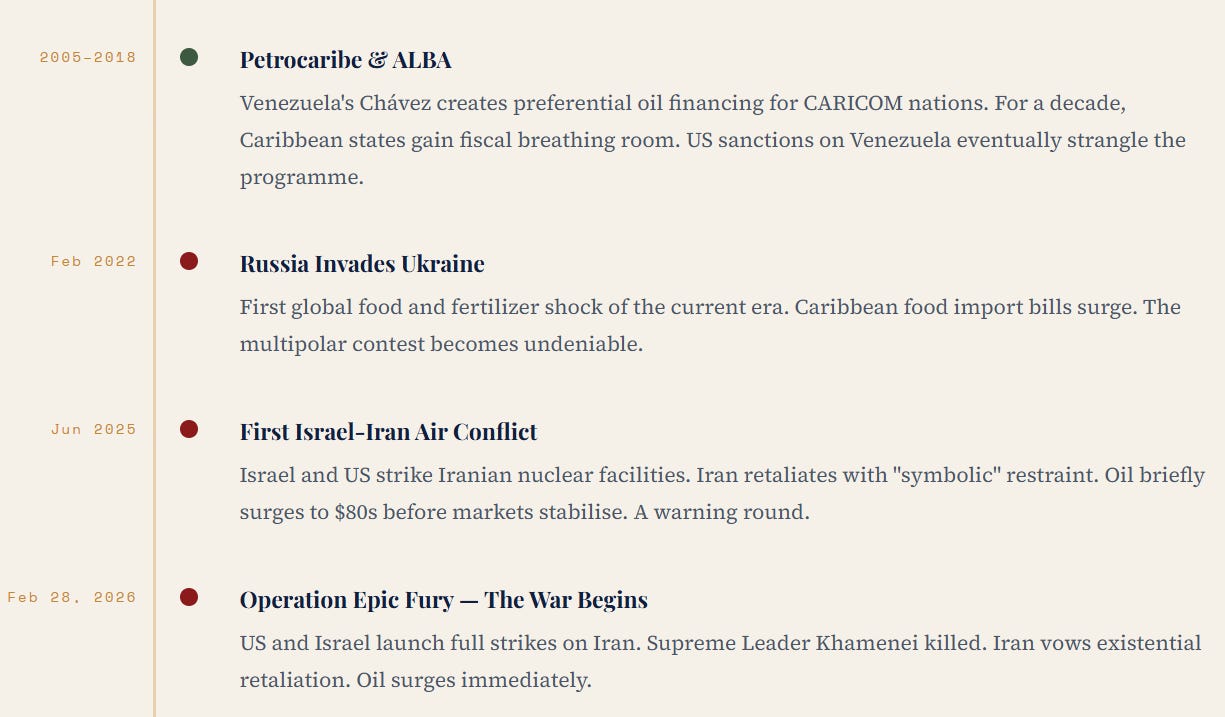
On February 28, 2026, the United States and Israel launched “Operation Epic Fury” against Iran — striking nuclear infrastructure, military command centres, and, fatally, killing Supreme Leader Ali Khamenei. Iran’s response departed from every precedent. Prior conflicts had involved what analysts politely called “symbolic retaliation.” This time, Iran was fighting for its existence.
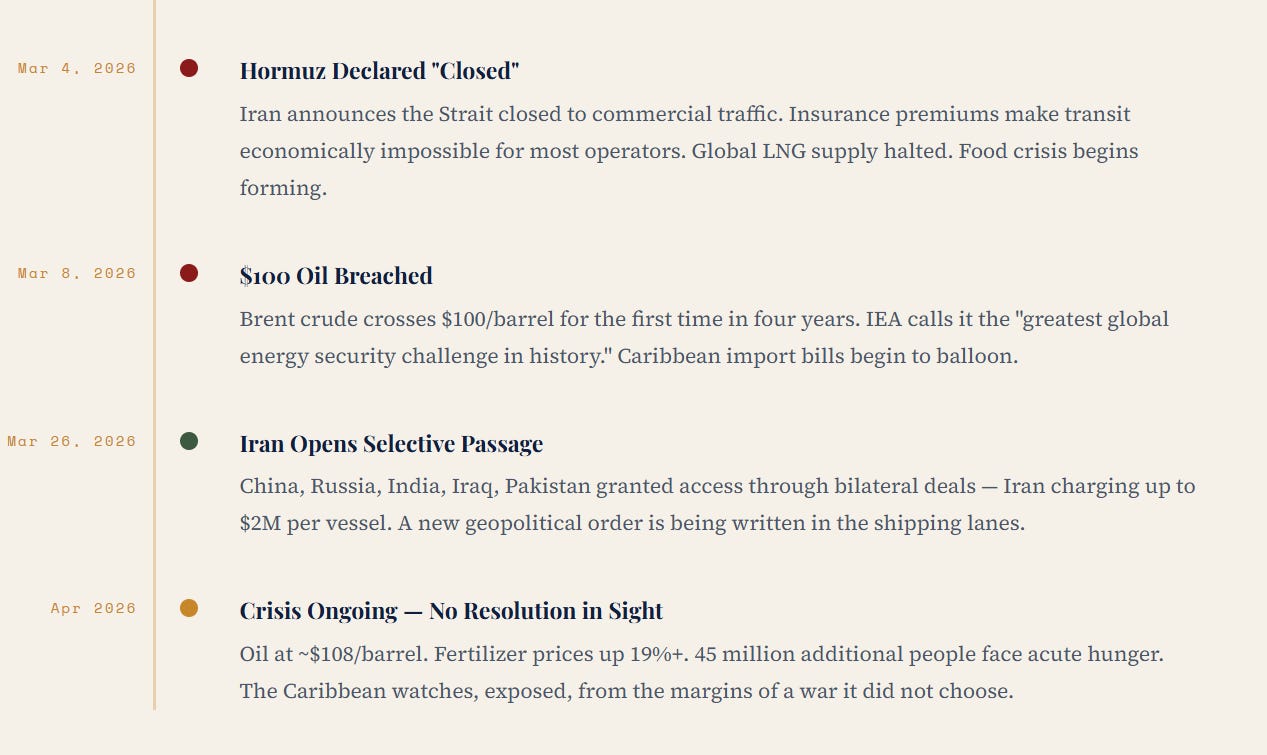
By March 4, Iranian forces had declared the Strait of Hormuz closed. Not threatened. Closed. The International Energy Agency’s executive director — a person trained in the careful diplomatic language of technocrats — called it “the greatest global energy security challenge in history.” This was not hyperbole. This was a man staring at the numbers.
Consider what flows through that 21-mile corridor on a normal day: roughly 20 million barrels of crude oil — representing one-fifth of all the oil consumed on earth. Every barrel of crude exported by Saudi Arabia, Iran, Iraq, Kuwait, Qatar, and the UAE must pass through it. It carries 20 percent of the world’s seaborne liquefied natural gas, nearly all of it from Qatar — the world’s third-largest LNG producer. It carries nitrogen fertilizers whose feedstock is that same natural gas, and those fertilizers grow food that feeds billions. The Strait is not a chokepoint. It is the jugular vein of industrial civilization.
For comparison: the Yom Kippur War of 1973 removed six percent of global oil supply from markets. The Iranian Revolution of 1979 removed four percent. The closure of the Strait of Hormuz removed twenty percent — three to five times the scale of any previous oil shock in history. The Dallas Federal Reserve’s economists, running their supply-disruption models, ran out of historical analogues.
When zero ships transited the Strait on March 16 — a day Brookings Institution analysts marked in near-disbelief — the civilizational implications crystallised. Qatar’s entire LNG production shut down. The Gulf’s “grocery supply emergency” began. Gulf states, which import over 80 percent of their caloric intake through that same corridor, watched supermarket shelves empty out within days. The world had spent decades building an energy system so concentrated, so dependent on one narrow channel, that a single determined actor with cheap drones could bring it to its knees.
Iran understood this. It has always understood this. The cheap drone, as one analyst noted, doesn’t need to sink every ship. It just needs to exist — to make every insurance underwriter, every ship captain, every oil trader recalculate the risk until the corridor becomes, in effect, unusable. War-risk insurance premiums surged from 0.125 percent of vessel value to between five and ten percent — a forty-fold increase. Freight rates tripled. The cost of everything made from, shipped by, or dependent on energy followed upward.
By late March, Iran had selectively reopened the Strait for vessels from China, Russia, India, Iraq, Pakistan, Malaysia, Thailand, and the Philippines — countries that had negotiated directly, signalling a new geopolitical architecture built not around international law but around bilateral relationships with Tehran. Iran was reportedly charging up to two million dollars per vessel for passage. The Strait of Hormuz had become, in a matter of weeks, a toll road managed by a country Washington had spent four decades trying to destroy.
The cascading consequences moved in waves outward from the Gulf, hitting every region in sequence, the poorest regions last and hardest:
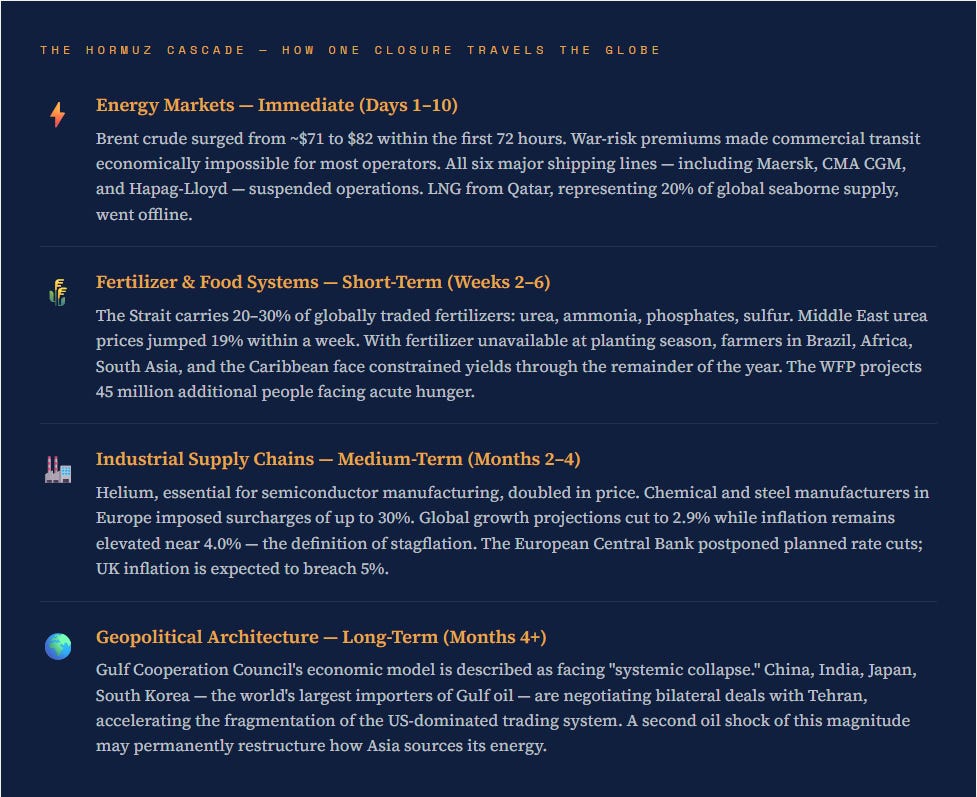
The Arsonist’s Blueprint: Trump, Greater North America, and the Death of Globalism
The chaos in the Gulf was not an accident of foreign policy. It was its objective.
To understand why Washington launched Operation Epic Fury — at the cost of $200 billion and counting, and with a war it admitted it could not quickly end — you must understand what Donald Trump’s inner circle actually wants. Not what they say in press conferences. What the architecture of their decisions reveals.
The “New World Order” that George H.W. Bush announced in 1991 was a specific arrangement: America as the world’s financial capital, manufacturing offshored to cheaper labour markets, security provided globally in exchange for dollar-denominated trade, and a liberal international order managed from Washington. For thirty years, this system generated extraordinary wealth — for American corporations, for Chinese factories, for Gulf petromonarchies, and for the financial class in every country that played along.
But the system had a rot in it. The offshoring gutted the American working class. The financialisation created spectacular inequality. The trade deficits compounded into debt. The political consensus that held the arrangement together frayed, and in 2016, America elected a man who had spent his life watching that rot from the outside, and who viscerally, instinctively understood that the arrangement was unsustainable even if he couldn’t articulate why in policy terms.
Trump’s “Trump World Order” — emerging in sharper relief with each passing month of his second term — is a fundamental rejection of that architecture. It prioritises moving America away from finance and toward resources and manufacturing. It advocates for what strategists call “Fortress America”: protected by oceans, energy self-sufficient, less dependent on global supply chains, and pursuing a form of Christian nationalist consolidation domestically while projecting economic dominance through control of essential resources.
The war in the Middle East, in this framework, is not a strategic mistake. It is an accelerant. By disrupting Gulf oil supplies — supplies that flow overwhelmingly to China, India, Japan, and South Korea — the United States forces the world’s largest economies into dependency on North American energy exports: American shale, Canadian oil sands, Venezuelan reserves (once subjugated), and potentially Arctic resources. Trump himself, when asked about rising gasoline prices, said: “If they rise, they rise.” This is not indifference. This is intent.
The ENERGY REALIGMENT IN NUMBERS80% of oil transiting Hormuz was destined for Asia pre-war (IEA, 2025). China receives 45–50% of its oil imports through the Strait.
Venezuela, Canada, and the United States emerge as the dominant alternative oil suppliers as Gulf output collapses — all within Washington’s sphere of influence or coercion.
US shale producers are already benefiting from $95–108/barrel prices, the highest sustained levels in years, as the administration openly pressures the Gulf to remain destabilised.
Qatar’s LNG complex at Ras Laffan was struck March 18, causing a 17% reduction in capacity requiring 3–5 years to fully repair — permanently redirecting Asian LNG buyers toward American exporters.
The ambitions do not stop at energy. Trump’s rhetoric around Greenland, Canada, Panama, and now Cuba and Venezuela is not bluster — it is the geographic expression of “Greater North America”: a resource-rich, self-sufficient continental bloc that can weather — and indeed profit from — a collapse of the existing global trading system. The Monroe Doctrine, dormant for decades beneath the veneer of multilateralism, is reasserting itself with modern tools and contemporary aggression.
The tragedy is this: the American system Trump is trying to save from its own contradictions is one built on violence, extraction, and inequality. The cure he is applying — more violence, more extraction, more unilateralism — will not fix the underlying disease. But it will, for a time, benefit certain Americans while distributing catastrophic costs to everyone who cannot fight back.
The Caribbean cannot fight back militarily. This is not a secret. It is the fundamental condition of our existence in this system.
The Patient Bear: Russia’s Third Rome and the Long Collapse
While America accelerates collapse, Russia waits for it — and shapes it.
Aleksandr Dugin — the Russian philosopher whose ideas have had more documented influence on Kremlin grand strategy than almost any living thinker — articulates what he calls the “Third Rome” project: the conviction that Western liberal civilisation is collapsing under the weight of its own contradictions, and that when it falls, Russia must be positioned to become a new civilisational centre.
The Russian strategy is therefore the photographic negative of Washington’s. Where Trump accelerates chaos to profit from it, Russia aims to remain stable while the chaos consumes its rivals. Putin’s playbook, observed across two decades, involves: consolidating domestic power through nationalism and Orthodox Christian identity; forming resilient economic alliances with countries resistant to Western pressure — Iran, China, India, Vietnam, BRICS members; industrialising the military economy around war production (Russia now manufactures more drones domestically than at any point in its history); and waiting for Western democracies to fracture from within under the weight of inequality, culture wars, and the economic consequences of imperial overreach.
Ukraine is, through this lens, not primarily a territorial dispute. It is Russia demonstrating that it can sustain a long war of attrition — economically and militarily — against a NATO-backed opponent without collapsing. It is a proof of concept. And it is working, in the sense that Russia’s economy has adapted, its military production has scaled, and Europe’s energy dependence on Russian gas — now partially replaced by Qatari LNG, which the Iran war has just disrupted — remains a structural vulnerability that Moscow can exploit at will.
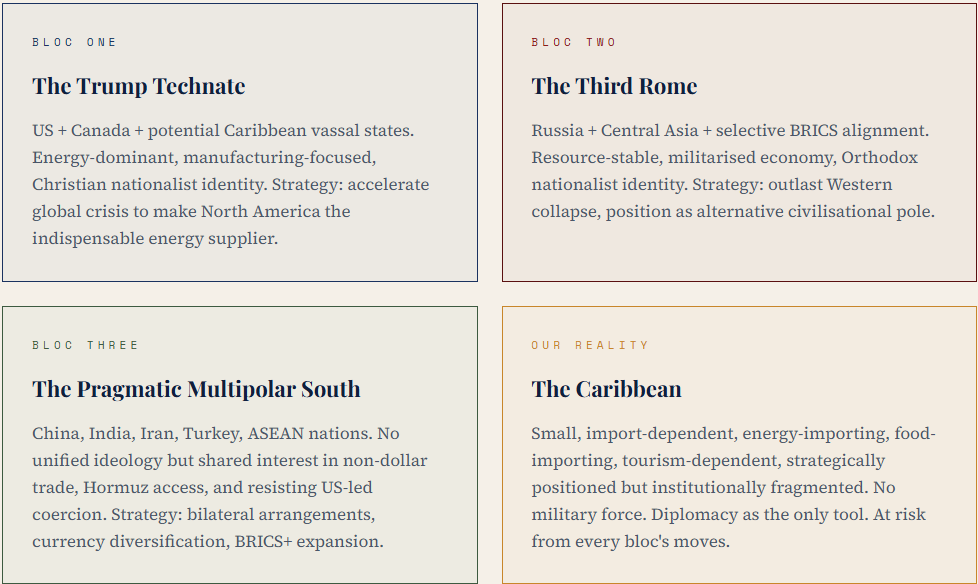
Two great powers are now engaged in a contest to manage — or profit from — the collapse of the world order that gave us relative peace since 1991. Neither of them has asked the Caribbean how we feel about it. Neither of them will.
Cuba in the Dark: The Blockade as Living History
America’s longest-running experiment in collective punishment — and what it tells us about everything else.
Before there was a Strait of Hormuz crisis. Before there was a Trump World Order. Before Aleksandr Dugin’s Third Rome entered the vocabulary of foreign policy analysts. There was Cuba. And the lessons of Cuba — seventy years of them — are the most precise guide we have to understanding what imperial power does when a small nation refuses to comply.
Cuba gained independence from Spain in 1898 and became, almost immediately, an American economic colony — sugar plantations, casinos, oil refineries, utilities, all controlled by American corporations or political allies. The 1959 revolution under Fidel Castro was not simply a left-wing uprising. It was a nationalisation project: an attempt by a small island nation to own its own resources and direct its own economic destiny. Washington’s response has been, for sixty-five years, to destroy the Cuban economy from outside until its government collapses from within.
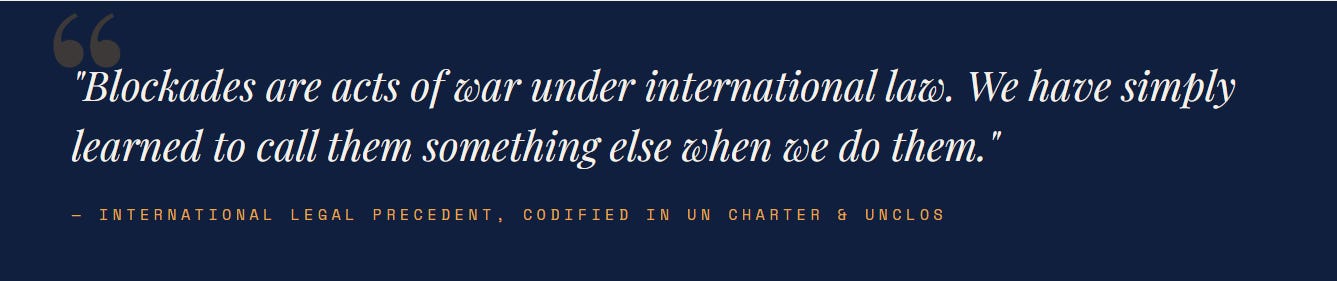
The blockade — called a “embargo” in American media to sanitise it, since a blockade is legally an act of war — has been condemned by the United Nations General Assembly every year for three decades. The vote in 2023 was 187 nations in favour of ending it, with only the United States, Israel, and sometimes Brazil voting against. The world has spoken. Nothing has changed.
What has changed is the intensity. In recent years, the blockade has been weaponised specifically to cut off energy. Cuban power plants run on oil. Without oil, water systems stop. Bakeries close. Surgeries are performed by the light of mobile phones. Ventilators run out. People die — not from bombs, but from the slow, grinding arithmetic of imposed scarcity. The current US president’s statement that he will do “what I want” with Cuba is not a threat of something new. It is a description of something that has been happening for decades, now spoken without the diplomatic cover of pretending otherwise.
There is a lineage here. The bombing of a Cuban civilian airliner over Barbados in 1976 — the first bombing of a commercial aircraft in the Western Hemisphere — was carried out by CIA-connected operatives. This is not conspiracy theory. The CIA itself has declassified documents corroborating the connection. No American official was ever held accountable. The message was received: in the Caribbean, the rules that apply elsewhere do not apply here. And the US exports its prison population, its deported gang members, its criminal exiles, to Caribbean governments that lack the resources, institutions, or legal frameworks to absorb them — destabilising island societies from the inside while strangling them from the outside.
Cuba matters to this analysis not as a curiosity — a Cold War remnant — but as a proof of concept. What America does to Cuba is what it does to any nation that refuses to comply. The tools are simply calibrated to the target’s size and strategic significance. Venezuela gets sanctions and coup attempts. Haiti gets repeated military intervention and the deliberate destruction of its state capacity. Nicaragua gets destabilisation. Grenada in 1983 got an outright invasion. Cuba gets the slow strangulation because Cuba has survived everything else.
The Caribbean has learned — through blood, through hunger, through the coffins of ordinary people — what international law cannot teach in a classroom: that for small nations, legality is not a shield. It is an argument. And arguments require listeners who care.
The Caribbean in the Storm: What the Hormuz Crisis Means for Us
When the world’s oil supply fractures, the Caribbean does not stand apart from the damage. It absorbs it.
The Caribbean’s Structural Exposure
Most Caribbean nations are net importers of food and energy. Tourism — the economic backbone of islands from Barbados to Jamaica to Grenada — depends on international travel, jet fuel costs, and the disposable income of visitors from economies now facing stagflation. Fertilizer imported from the Gulf feeds regional agriculture. The cascading costs of the Hormuz crisis translate, on Caribbean streets, into higher food prices, higher electricity costs, higher import bills, and constrained foreign exchange from a tourism sector hit by cost-of-living squeezes in source markets.
Petrocaribe — the Venezuelan oil programme that once provided preferential financing for Caribbean energy imports, allowing CARICOM nations to redirect savings into social development — was systematically undermined through US sanctions on Venezuela. ALBA, the Bolivarian alliance that offered an alternative economic architecture, was similarly strangled. The tools the Caribbean once had to buffer external shocks have been removed. The shocks remain.
What the Hormuz crisis adds is a second compounding shock on top of post-COVID inflation, the lingering consequences of the Ukraine war’s fertilizer disruption, and debt levels that constrain fiscal response. The International Monetary Fund’s model suggests that an oil price at $110/barrel — a figure already exceeded in this crisis — produces approximately a 14% increase in food prices for oil-importing nations. For the Caribbean’s poor, who spend 50–70% of their income on food, this is not an economic statistic. It is hunger.
The war’s effects travel through specific channels that the Caribbean must track with precision:
Tourism revenue compression: As European and North American economies face stagflation — simultaneous rising inflation and slowing growth — discretionary spending on international travel contracts. Airlines pass on jet fuel surcharges. Visitors spend less or holiday closer to home. For Jamaica, Barbados, St. Lucia, Grenada, and the rest of the tourism-dependent Eastern Caribbean, this is a direct revenue threat arriving at a moment when debt servicing already consumes enormous proportions of public budgets.
Import bill explosion: The Caribbean imports almost everything it consumes — from electronics to wheat flour to petroleum products. As oil prices rise, the cost of shipping rises. As fertilizer costs spike, the cost of imported food rises. As insurance premiums climb, trade finance becomes more expensive. Every link in the import chain costs more, simultaneously.
Remittance vulnerability: Diaspora communities in the United States, United Kingdom, and Canada are economic lifelines for families across the Caribbean. As these economies face job losses, inflation-squeezed disposable incomes, and rising uncertainty, remittance flows — which for some CARICOM states represent 15–25% of GDP — face compression.
Strategic exposure: As the United States increasingly frames the Caribbean as its strategic backyard — demanding compliance on Cuba, Venezuela, and China engagement — small island states face a coercive binary: align with Washington’s “Greater North America” project and lose diplomatic sovereignty, or resist and risk the same toolkit applied to Cuba, Haiti, and Grenada before them.
Errol Barrow said it in 1983, and it remains the only sustainable posture: “friends of all, satellites of none.” But in 2026, saying it requires more than pride. It requires an economic foundation that does not exist — yet.
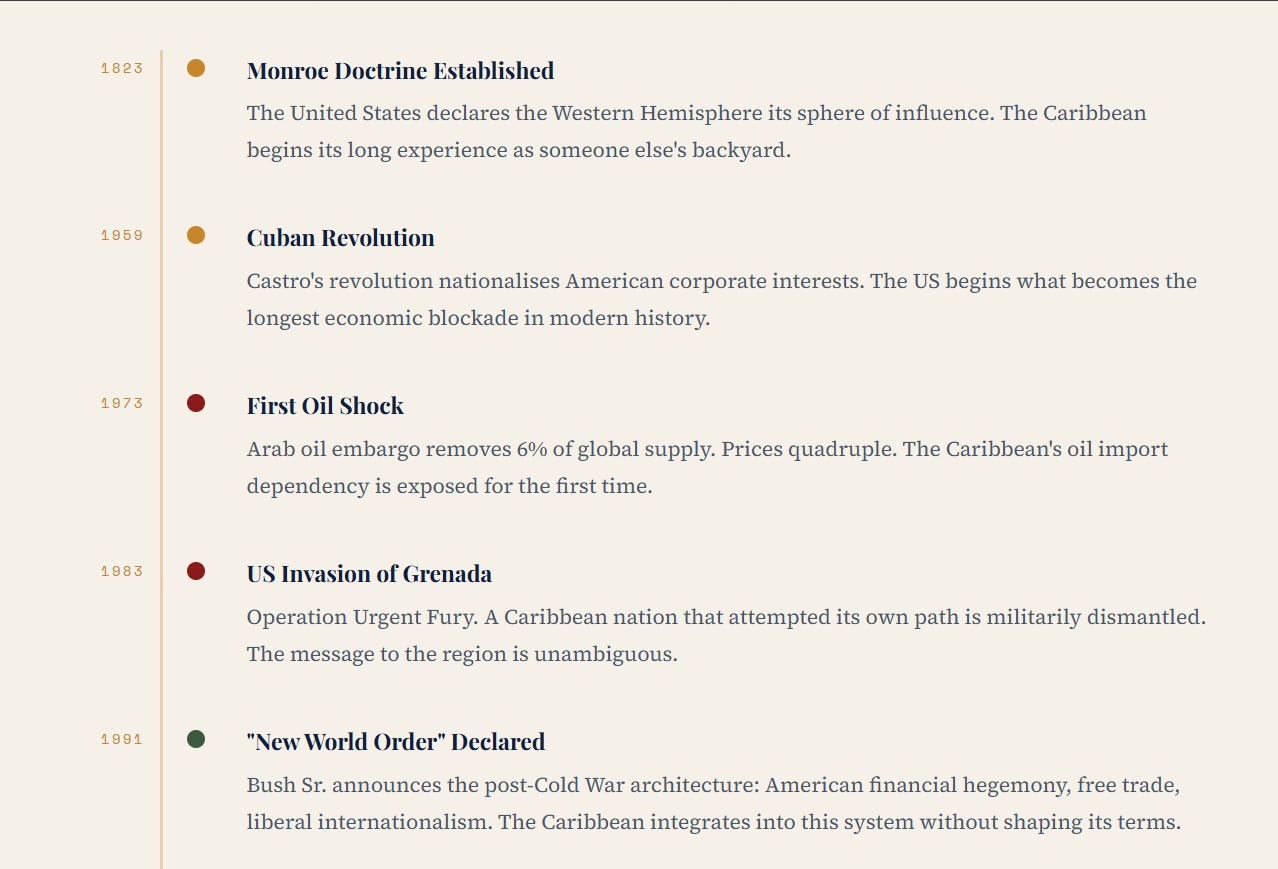
How We Got Here: A Compressed History of the Crisis

The Reckoning: What the Caribbean Must Understand, and What It Must Build
Pride and dignity, as Errol Barrow understood, must be matched with architecture.
It has been observed — by Frantz Fanon, by CLR James, by Walter Rodney, by every serious Caribbean intellectual who has looked at the structure of the world honestly — that small nations facing great powers cannot win through confrontation. They survive through positioning, through alliance-building, through the construction of enough internal capacity that the cost of coercion exceeds its benefits. This is the diplomatic tradition Barrow articulated. It is the tradition Caribbean people must now extend into new terrain.
Several things are becoming undeniably clear in the light of this crisis:
Energy sovereignty is existential, not aspirational. Every Caribbean nation that imports its energy — which is almost all of them — is structurally at the mercy of global commodity price shocks it cannot control. The Petrocaribe era demonstrated that this dependency can be temporarily buffered through political relationships. The destruction of Petrocaribe demonstrated that buffers built on another country’s political will can be removed overnight. The only durable buffer is domestic renewable energy infrastructure: solar, wind, geothermal where available, battery storage, and regional energy grids. This is not a nice-to-have. In a world moving toward permanent energy volatility, it is the difference between sovereignty and servitude.
Food production is a security issue. The Caribbean imports the bulk of what it eats. This is a choice — one made over decades of colonial and post-colonial economic distortion — and it can be partially reversed. The fertilizer crisis illuminates why this matters: when global fertilizer supply chains fracture, countries with domestic food production capacity survive. Countries without it depend on emergency aid from the same powers that created the crisis. CARICOM must treat regional food production — expanding it, protecting it, investing in it — as a strategic priority equivalent to military defence.
Institutional coherence is non-negotiable. CARICOM’s structural weakness is not primarily financial. It is political: fifteen separate governments, fifteen separate development agendas, fifteen separate bilateral relationships with Washington, London, and Beijing, negotiating from positions of individual smallness instead of collective weight. Every trade negotiation the Caribbean enters alone, it enters as a supplicant. Every negotiation it enters as a bloc, it enters with leverage. The West Indian Federation failed in 1962. The integration project has never recovered. In a world of blocs — Trump’s technate, Dugin’s Third Rome, the multipolar south — a fragmented Caribbean is not a neutral actor. It is an easy target.
The arc of the moral universe bends toward justice — but only with human hands guiding it. Martin Luther King’s phrase is often quoted as comfort. It should be read as instruction. The world does not automatically improve. Hegemons do not reform themselves out of moral awakening. They are constrained by cost — by the economic pain of prolonged wars, by the political cost of body bags, by the rising weight of an international legitimacy they desperately claim but increasingly violate. The Caribbean’s role is to add to that weight, consistently, through every multilateral forum available: the UN, the ICJ, the WTO, the Commonwealth, the Community of Latin American and Caribbean States. Diplomacy is not weakness. In the absence of military force, diplomacy prosecuted with intelligence, consistency, and moral clarity is power.
There is also this: the world is changing faster than our institutions can track. BRICS has expanded. The dollar’s dominance in commodity trade — already challenged by Iran demanding yuan for Hormuz passage — is eroding. The Global South is not a unified bloc, but it is increasingly a negotiating space. Caribbean nations must position themselves to operate within the emerging multipolar architecture without surrendering to any single pole. This requires diplomatic skill, economic diversification, and above all, a strategic clarity about what we are — and what we refuse to become.
Small nations like those in the Caribbean are not irrelevant. The stapes bone in the human ear is among the smallest bones in the body. Without it, the entire architecture of hearing collapses. The Caribbean’s role — as a moral voice, as a living demonstration of what multiracial, multicultural, multilingual humanity can build in the aftermath of history’s worst crimes — matters. Our position at the junction of the Atlantic, our proximity to the world’s most powerful empire, our demographic ties to Africa, Europe, Asia, and the Americas: these are not disadvantages. They are a unique vantage point on the world’s crises and a unique capacity to speak across the divides that are destroying it.
But vantage points do not feed children. Moral clarity does not pay import bills. The work is both visionary and material, both philosophical and structural. The Caribbean must do both, simultaneously, with urgency it has not yet mustered.
The world is closer to organised catastrophe than at any point since 1962 — and the Doomsday Clock knows it. The question is not whether the tremors of the Gulf war will reach Caribbean shores. They already have. The question is whether we will build the internal architecture — the renewable energy, the food security, the institutional coherence, the diplomatic weight — to absorb those tremors without fracturing.
The eight billion people on this planet have, collectively, enough intelligence to stop killing each other. That is the hope. But hope without strategy is just prayer. And prayer, in 2026, requires a backup plan.
“We are friends of all, and satellites of none. But we must build the foundations that make this more than a beautiful sentence.”
What a comprehensive and insightful article. The issues for the Caribbean also resonate in the Small Island Developing States in the Pacific and for countries like Australia and New Zealand. Thank you!